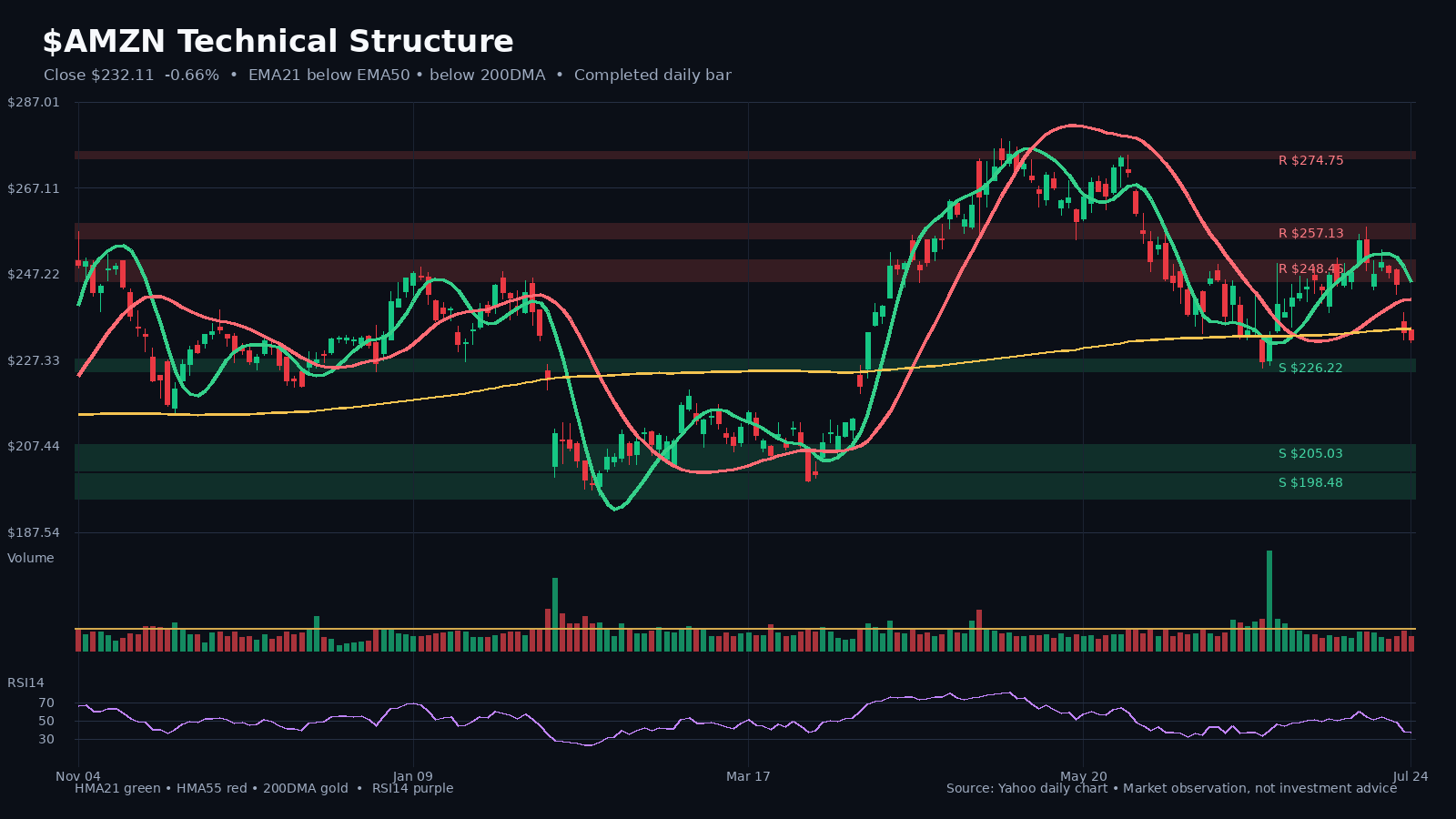
AMZN market-structure snapshot
Latest close on July 24, 2026: $232.11 (-0.7% on the latest daily bar). HMA21 / HMA55: $245.53 / $241.51. 200DMA: $234.59. Relative volume: 0.64x the 20-day average.
Latest close on July 24, 2026: $232.11 (-0.7% on the latest daily bar). HMA21 / HMA55: $245.53 / $241.51. 200DMA: $234.59. Relative volume: 0.64x the 20-day average.
AMZN latest SEC/Yahoo fundamental and valuation snapshot
Latest comparable filing period: 2026 Q1 ending 2026-03-31; filed 2026-04-30. Comparable growth: revenue +16.6% YoY; net income +76.7% YoY; diluted EPS +74.8% YoY.
Latest comparable filing period: 2026 Q1 ending 2026-03-31; filed 2026-04-30.
Comparable growth: revenue +16.6% YoY; net income +76.7% YoY; diluted EPS +74.8% YoY.
Quality and cash conversion: net margin 16.7% (+567 bp YoY); YTD SEC free-cash-flow proxy $141.11B (+29.5% YoY).
Valuation snapshot: trailing P/E 27.8x; forward P/E 23.4x; EV/EBITDA 16.6x; P/S 3.4x.
Net income grew faster than revenue, indicating positive earnings leverage in the comparable period.
Cash generation improved versus the comparable period.
Amazon: High-frequency issuance constitutes a credit "hanging river", the retail sector is under pressure, and the rating is downgraded to underweight (Barclays)
Barclays downgraded Amazon and the retail sector to "cautious rating." The main reason is that as a high-frequency issuer, Amazon's future supply hangover and rising premium on new issuances will suppress its credit performance, and it is estimated that its balance sheet still has room for further borrowing of US$25-35 billion. Amazon accounts for 35% and 25% of the U.S. and European investment-grade retail indices respectively, and its issuance has turned the sector's excess returns negative.
Barclays downgraded Amazon and the retail sector to "cautious rating." The main reason is that as a high-frequency issuer, Amazon's future supply hangover and rising premium on new issuances will suppress its credit performance, and it is estimated that its balance sheet still has room for further borrowing of US$25-35 billion. Amazon accounts for 35% and 25% of the U.S. and European investment-grade retail indices respectively, and its issuance has turned the sector's excess returns negative.
The era of smart e-commerce is coming and will contribute 6% of incremental GMV in the next five years. Amazon and Alibaba are the kings (Morgan Stanley)
Morgan Stanley released an in-depth report, pointing out that AI-driven agents are becoming personal digital shopping assistants. It is expected that more than 20% of e-commerce GMV will be affected in the next five years, bringing about a 6% increase in the total market size, pushing the scale of global e-commerce to reach 7 trillion US dollars in 2030, and the CAGR from 2025 to 2030 will increase from the previous 7% to 9%.
Morgan Stanley released an in-depth report, pointing out that AI-driven agents are becoming personal digital shopping assistants. It is expected that more than 20% of e-commerce GMV will be affected in the next five years, bringing about a 6% increase in the total market size, pushing the scale of global e-commerce to reach 7 trillion US dollars in 2030, and the CAGR from 2025 to 2030 will increase from the previous 7% to 9%.