From AI Infrastructure Faith to Counting the Cost: Big Tech’s Capital-Spending Story Hits a Turning Point
“If Google cuts capital spending, will its stock rise? Most people’s answer is: It will fall even more.” In a recent discussion with overseas investors, Huang Leping, chief analyst for overseas technology at Huatai Securities, observed that AI development has not peaked, but its driving force has shifted from price increases to capacity expansion. The companies paying for that expansion have also started counting the cost. Based on analyses by several overseas-market analysts, capital spending has become the central point of tension in the overseas AI value chain. Under sustained pressure from capital markets, cloud service providers, or CSPs, will need to do two things to achieve a sustained recovery in their share prices: proactively adjust their capital-spending behavior and win market recognition for doing so, while also hoping for a major breakthrough in AI monetization that produces clear, verifiable revenue and return data to address doubts about the business model. Investors start counting the cost One force behind the hardware sector’s continued gains over the past two years has been the repeated increase in capital spending by cloud providers. According to the Huatai Securities Research Institute, the five largest North American cloud providers had combined capital expenditures of $411.5 billion in 2025 as of July 23. The consensus forecast is about $773.9 billion for 2026, up 88% year over year, and about $1.02 trillion for 2027, up 32%. In aggregate, there is no sign of a slowdown. But companies appear to have started counting the cost of tokens. Huang cited the example of a U.S. mobility platform whose engineering team used up its entire annual AI budget in four months. The company responded by setting a monthly spending cap of $1,500 for each employee and each tool. Models at different price points were then arranged along a cost-effectiveness curve: inexpensive models handled simple tasks, while the most advanced models were reserved for complex work. The logic used to interpret cloud providers’ earnings reports has also changed. Google reported on July 24 that cloud revenue had risen 82% year over year in the second quarter, while capital spending had not contracted and had instead been raised further. The next day, Google led the hardware sector lower. That suggested investors were beginning to question whether the correlation between capital spending and hardware-sector performance was breaking down. Another heavily debated issue is circular financing. Since 2025, chip companies including Nvidia and AMD have provided financing to laboratories such as OpenAI and Anthropic in exchange for chip orders. This makes demand difficult to assess: when part of the revenue comes from money invested by upstream companies themselves, outside observers have difficulty distinguishing genuine market adoption. More importantly, the trend appears to be spreading from chip companies to memory manufacturers. Huang said that counting the cost does not mean companies are stopping. Businesses are still buying tokens, cloud providers are still increasing capital spending, and manufacturing investment is expected to double over three years. But a series of details—from companies setting spending caps for each tool, to investors asking about returns and funding sources, to Taiwan Semiconductor Manufacturing Co. refusing to provide financing to customers—points to a common conclusion: this investment cycle is moving from being driven by confidence to being driven by calculation. “For the market, this is not necessarily bad news. The real risk has never been that people start counting the cost; it is that no one does,” he said. Capital spending becomes the focus of trading Although technology companies’ earnings remain strong, their shares have recently shown a pattern in which positive earnings news is met with selling. Chen Meng, an overseas-strategy analyst at Soochow Securities, said U.S. stocks are approaching what is likely to be the most important recent collision of economic data and earnings reports. Short-term volatility is likely to rise further, and the market’s near-term pressure probably has not run its course. For cloud providers, the market’s main concern is no longer revenue, but whether free cash flow can remain positive. A move to negative cash flow would mean that major CSPs would eventually have to turn to debt to support capital spending. The macro liquidity environment is currently tightening at the margin, while higher borrowing costs and tighter liquidity are occurring at the same time—an unfavorable combination for companies with high capital requirements. Therefore, even if revenue and profit continue to exceed market expectations, the valuation adjustment triggered by capital spending is unlikely to be over if more providers confirm a trend toward negative free cash flow. “U.S. technology stocks are currently in a painful, confused trading environment centered on expectations for AI capital spending,” said Chen Junyun, chief analyst for forward-looking research at CITIC Securities. Considering three core dimensions—funding sources, willingness in financial markets and supply-chain constraints—he judged that the market would probably trade in the near term around a slowdown in the growth of AI capital spending. For the market to enter a phase of directional choice, he said, several key variables would need to become clear, including a breakthrough in AI monetization, greater downward pressure on CSP share prices and a decline in inflation in memory-chip prices. Chen also said that, regardless of how the scenarios develop, CSP companies would remain relatively better positioned within the technology sector. If CSP shares continue to fall, it would mean the market is pricing in a further slowdown in AI capital-spending growth, and semiconductor hardware stocks—an area directly linked to downstream capital spending—would also be unlikely to avoid the pressure. If AI monetization breaks through, or if CSP companies proactively adjust capital spending and are rewarded by the market, their shares would be expected to recover first and quickly.
Based on analyses by several overseas-market analysts, capital spending has become the central point of tension in the overseas AI value chain. Under sustained pressure from capital markets, cloud service providers, or CSPs, will need to do two things to achieve a sustained recovery in their share prices: proactively adjust their capital-spending behavior and win market recognition for doing so, while also hoping for a major breakthrough in AI monetization that produces clear, verifiable revenue and return data to address doubts about the business model.
Investors start counting the cost
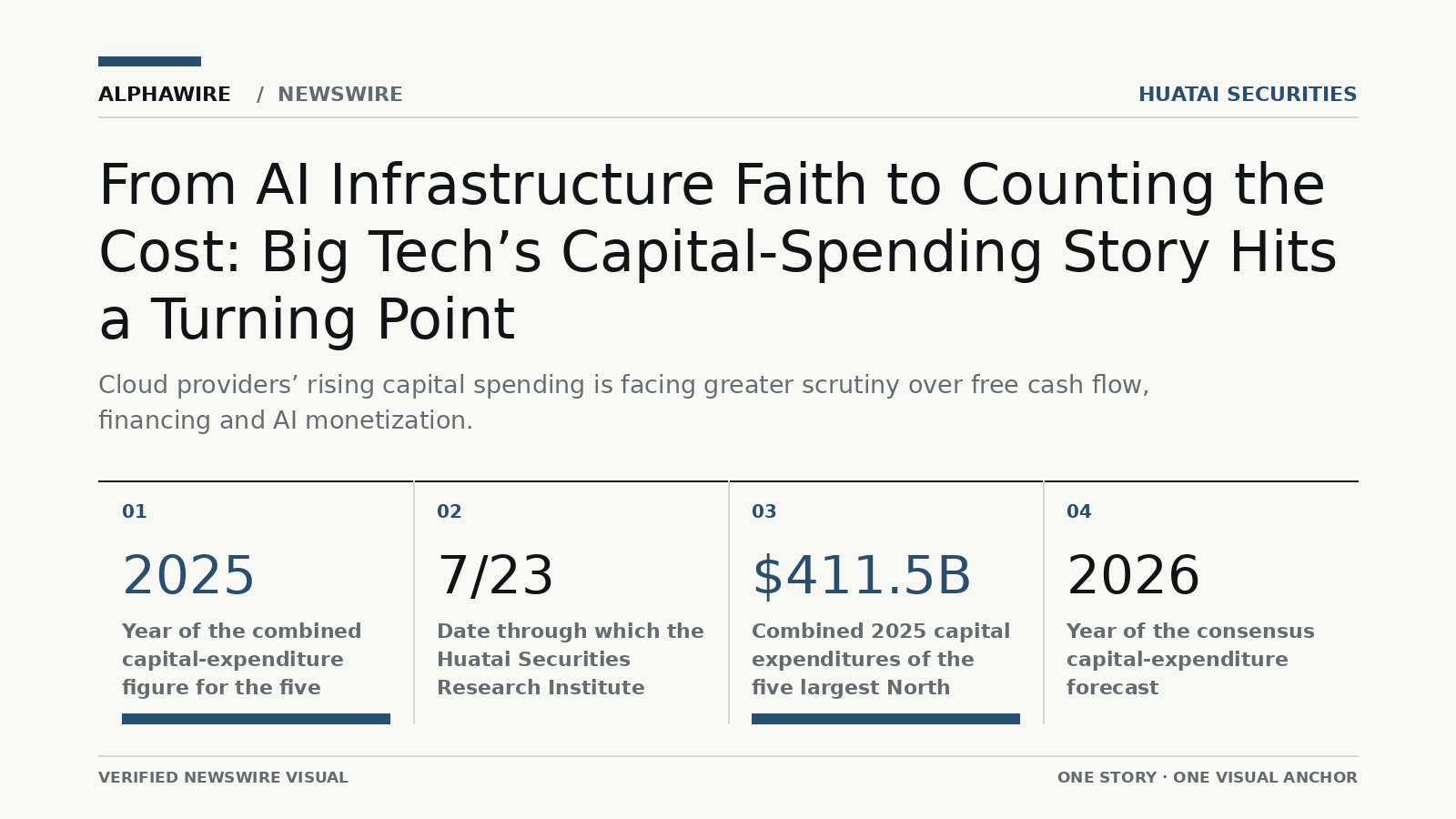
One force behind the hardware sector’s continued gains over the past two years has been the repeated increase in capital spending by cloud providers. According to the Huatai Securities Research Institute, the five largest North American cloud providers had combined capital expenditures of $411.5 billion in 2025 as of July 23. The consensus forecast is about $773.9 billion for 2026, up 88% year over year, and about $1.02 trillion for 2027, up 32%. In aggregate, there is no sign of a slowdown.
But companies appear to have started counting the cost of tokens. Huang cited the example of a U.S. mobility platform whose engineering team used up its entire annual AI budget in four months. The company responded by setting a monthly spending cap of $1,500 for each employee and each tool. Models at different price points were then arranged along a cost-effectiveness curve: inexpensive models handled simple tasks, while the most advanced models were reserved for complex work.
The logic used to interpret cloud providers’ earnings reports has also changed. Google reported on July 24 that cloud revenue had risen 82% year over year in the second quarter, while capital spending had not contracted and had instead been raised further. The next day, Google led the hardware sector lower. That suggested investors were beginning to question whether the correlation between capital spending and hardware-sector performance was breaking down.
Another heavily debated issue is circular financing. Since 2025, chip companies including Nvidia and AMD have provided financing to laboratories such as OpenAI and Anthropic in exchange for chip orders. This makes demand difficult to assess: when part of the revenue comes from money invested by upstream companies themselves, outside observers have difficulty distinguishing genuine market adoption. More importantly, the trend appears to be spreading from chip companies to memory manufacturers.
Huang said that counting the cost does not mean companies are stopping. Businesses are still buying tokens, cloud providers are still increasing capital spending, and manufacturing investment is expected to double over three years. But a series of details—from companies setting spending caps for each tool, to investors asking about returns and funding sources, to Taiwan Semiconductor Manufacturing Co. refusing to provide financing to customers—points to a common conclusion: this investment cycle is moving from being driven by confidence to being driven by calculation. “For the market, this is not necessarily bad news. The real risk has never been that people start counting the cost; it is that no one does,” he said.
Capital spending becomes the focus of trading
Although technology companies’ earnings remain strong, their shares have recently shown a pattern in which positive earnings news is met with selling.
Chen Meng, an overseas-strategy analyst at Soochow Securities, said U.S. stocks are approaching what is likely to be the most important recent collision of economic data and earnings reports. Short-term volatility is likely to rise further, and the market’s near-term pressure probably has not run its course. For cloud providers, the market’s main concern is no longer revenue, but whether free cash flow can remain positive.
A move to negative cash flow would mean that major CSPs would eventually have to turn to debt to support capital spending. The macro liquidity environment is currently tightening at the margin, while higher borrowing costs and tighter liquidity are occurring at the same time—an unfavorable combination for companies with high capital requirements. Therefore, even if revenue and profit continue to exceed market expectations, the valuation adjustment triggered by capital spending is unlikely to be over if more providers confirm a trend toward negative free cash flow.
“U.S. technology stocks are currently in a painful, confused trading environment centered on expectations for AI capital spending,” said Chen Junyun, chief analyst for forward-looking research at CITIC Securities. Considering three core dimensions—funding sources, willingness in financial markets and supply-chain constraints—he judged that the market would probably trade in the near term around a slowdown in the growth of AI capital spending. For the market to enter a phase of directional choice, he said, several key variables would need to become clear, including a breakthrough in AI monetization, greater downward pressure on CSP share prices and a decline in inflation in memory-chip prices.
Chen also said that, regardless of how the scenarios develop, CSP companies would remain relatively better positioned within the technology sector. If CSP shares continue to fall, it would mean the market is pricing in a further slowdown in AI capital-spending growth, and semiconductor hardware stocks—an area directly linked to downstream capital spending—would also be unlikely to avoid the pressure. If AI monetization breaks through, or if CSP companies proactively adjust capital spending and are rewarded by the market, their shares would be expected to recover first and quickly.