Five-Year CDs Return at Major Banks as Smaller Lenders Continue Cutting Long-Term Deposit Rates
Five-year certificates of deposit have reappeared on the product shelves of China’s major state-owned banks, while many smaller and regional banks continue to cut rates on long-term time deposits, highlighting a divergence in liability-management strategies. On Aug. 2, a review by the Beijing Business Today found that Industrial and Commercial Bank of China, China Construction Bank, Agricultural Bank of China and Bank of China had recently begun offering five-year certificates of deposit, with annual rates as high as 1.60%. By contrast, several smaller banks in Henan, Zhejiang and Guizhou provinces were still lowering rates on long-term fixed-term deposits to control the cost of long-term liabilities. For depositors, the current low-yield environment appears to be a long-term trend, requiring new expectations about deposit maturities and liquidity planning. Five-year CDs return at the four major banks Five-year certificates of deposit from China’s major state-owned banks, which had largely disappeared from the market, have returned. On Aug. 2, the Beijing Business Today found that ICBC’s mobile banking app had recently listed two five-year CD products. Both required a minimum deposit of CNY 200,000; their annual rates were 1.60% and 1.55%, respectively. The products allowed transfers and partial early withdrawals. As of press time, the reference remaining purchase quota for each product exceeded CNY 10 million, indicating relatively ample supply. CCB’s mobile banking app showed that its CDs currently covered maturities ranging from one month to five years. The rate on its five-year CD was 1.60%. Bank of China launched the first batch of its 2026 personal CDs on July 1, offering seven maturities: one month, three months, six months, one year, two years, three years and five years. Its standard personal CD offered a five-year annualized rate of 1.60% and required a minimum deposit of CNY 200,000. The product did not automatically roll over at maturity and paid principal and interest at maturity. On Aug. 2, the Beijing Business Today found two five-year CDs currently on sale through the bank’s mobile app: a standard product with an annualized rate of 1.60% and a No. 3 product with an annualized rate of 1.55%. Agricultural Bank of China had also issued Jinsui 2026 Series No. 33 personal five-year CDs, with an annualized rate of 1.60% and a minimum deposit of CNY 200,000. The product could be purchased only at bank counters. Postal Savings Bank of China and Bank of Communications had no CDs on sale at the time. Major state-owned banks had collectively withdrawn five-year CDs around November 2025. Dong Ximiao, chief economist at China Merchants Union Consumer Finance, said the relaunch was a phased decision driven by multiple considerations, including liability management, retaining funds, market competition and improving net interest margins. He said it did not represent a reversal of the longer-term trend and that future supply would remain limited. Smaller banks continue to cut rates In contrast with the major state-owned banks’ measured reopening of long-term CDs, regional smaller banks are continuing to tighten the cost of medium- and long-term deposits. Several smaller banks in Henan, Zhejiang and Guizhou recently adjusted their deposit rates. On Aug. 1, Yiyang Xingfu Village Bank in Henan adjusted the rates on its renminbi time deposits. The revised annual rates for three-year and five-year fixed-term deposits were 1.50% and 1.35%, respectively, down from 1.60% and 1.45%. Jiaojiang Rural Commercial Bank in Zhejiang also adopted its latest posted deposit rates. Its revised rates for three-year and five-year time deposits were 1.6% and 1.5%, respectively, each 20 basis points lower than before. A bank in Guizhou also followed with an adjustment to its personal fixed-term deposit rates. On July 29, Guiding Hengsheng Village Bank cut rates on three-year and five-year fixed-term deposits, using different tiers based on deposit size. For deposits below CNY 50,000, the annual rates for both maturities were reduced to 1.75%. For deposits of CNY 50,000 or more, the annual rates for both maturities were set at 1.85%. The tiered adjustment was intended to optimize the bank’s liability structure and reduce the cost of long-term funds. Many smaller banks previously relied on higher long-term deposit rates to attract customers and create a differentiated deposit-gathering tool. But as net interest margins have continued to narrow, that model has become difficult to sustain. The reduction of long-term deposit costs has become a broad trend among regional smaller banks, not just the institutions mentioned above. Gao Zhengyang, a specially appointed researcher at Sushang Bank, said the core reason smaller banks have recently cut long-term deposit rates is that the loan prime rate has remained low, putting continued pressure on banks’ net interest margins. Lower deposit rates can reduce liability costs and help stabilize net interest margins, he said. Long-term deposit rates may also become the focus of future adjustments as smaller banks seek to optimize their liability structures, making tighter control of high-cost, long-term liabilities more likely. Banks pursue different liability strategies The contrasting moves reflect different considerations as banks adjust their asset-liability structures. For major state-owned banks, restarting five-year CDs is primarily a phased liability-management measure. Smaller banks, meanwhile, generally have narrower customer-acquisition channels and weaker brand recognition. Cutting the cost of long-term deposits and optimizing their liability structures are therefore choices based on their own asset-liability positions. Given banks’ different business positioning and liability-management needs, Dong said the likelihood that more banks would broadly follow by issuing five-year CDs was low, although some smaller banks might follow reluctantly. He said that, among nationwide banks, the banking sector’s net interest margin had fallen to a historic low of 1.40%. Extending deposit maturities would increase pressure on liability costs, and the industrywide trend toward shortening deposit maturities that began at the end of 2025 had not reversed. Major banks therefore had little incentive to follow suit. However, some smaller banks with weak brand recognition and limited customer-acquisition channels might be forced to issue similar products to prevent deposits from moving to major banks. Dong said that decision would depend on each bank’s asset-liability position, liquidity needs and interest-rate expectations and was not inevitable. The actions of smaller banks regarding long-term deposits also support this trend. An official at a local city commercial bank told the Beijing Business Today that the banking industry’s net interest margins were under continued pressure and that smaller banks faced significant operating challenges. The high cost of long-term deposits had become an important constraint on profitability, the official said. The bank had previously tried offering long-term CDs but quickly found that funding costs could not be matched with asset returns, intensifying pressure on the liability side. It therefore gradually lowered long-term deposit rates, focused on short- and medium-term deposit products, and prioritized liability-structure optimization. At the same time, it increased lending support for local small and microenterprises and individual businesses to improve asset-side pricing power and balance costs with returns. As net interest margins continue to narrow, smaller banks need to rebuild their profit models, shifting from excessive reliance on interest income toward more diversified revenue structures. Gao recommended strengthening services to the local real economy and developing specialized sectors to improve risk-pricing capabilities; accelerating the growth of intermediary businesses to raise the share of fee and service income and reduce reliance on net interest margins; and proactively advancing digital transformation to improve operating efficiency, strengthen risk controls and reduce costs while increasing efficiency. He also called for stronger dynamic asset-liability management and more efficient use of funds while keeping risks under control.
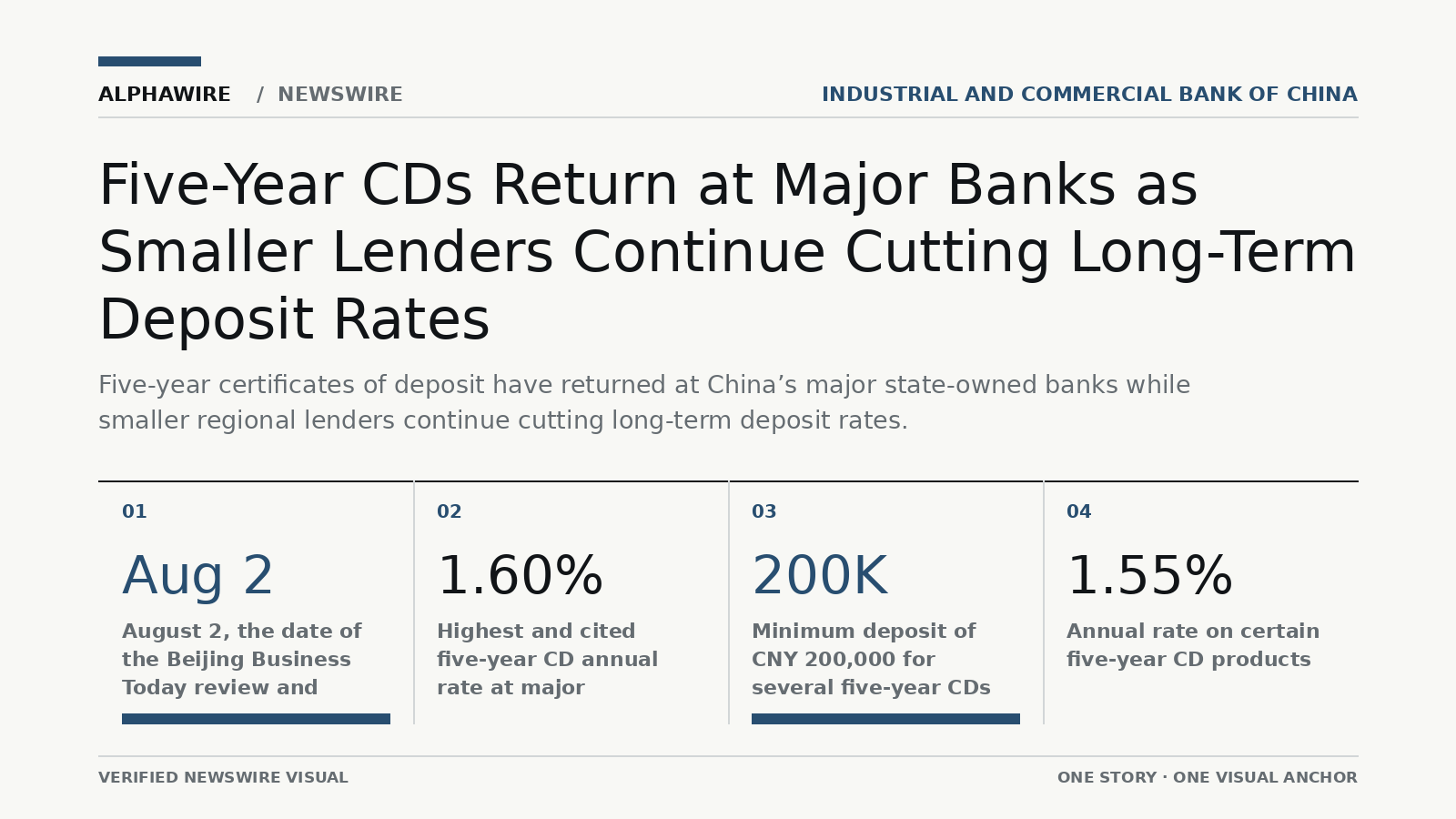
On Aug. 2, a review by the Beijing Business Today found that Industrial and Commercial Bank of China, China Construction Bank, Agricultural Bank of China and Bank of China had recently begun offering five-year certificates of deposit, with annual rates as high as 1.60%. By contrast, several smaller banks in Henan, Zhejiang and Guizhou provinces were still lowering rates on long-term fixed-term deposits to control the cost of long-term liabilities.
For depositors, the current low-yield environment appears to be a long-term trend, requiring new expectations about deposit maturities and liquidity planning.
Five-year CDs return at the four major banks
Five-year certificates of deposit from China’s major state-owned banks, which had largely disappeared from the market, have returned. On Aug. 2, the Beijing Business Today found that ICBC’s mobile banking app had recently listed two five-year CD products. Both required a minimum deposit of CNY 200,000; their annual rates were 1.60% and 1.55%, respectively. The products allowed transfers and partial early withdrawals. As of press time, the reference remaining purchase quota for each product exceeded CNY 10 million, indicating relatively ample supply.
CCB’s mobile banking app showed that its CDs currently covered maturities ranging from one month to five years. The rate on its five-year CD was 1.60%.
Bank of China launched the first batch of its 2026 personal CDs on July 1, offering seven maturities: one month, three months, six months, one year, two years, three years and five years. Its standard personal CD offered a five-year annualized rate of 1.60% and required a minimum deposit of CNY 200,000. The product did not automatically roll over at maturity and paid principal and interest at maturity. On Aug. 2, the Beijing Business Today found two five-year CDs currently on sale through the bank’s mobile app: a standard product with an annualized rate of 1.60% and a No. 3 product with an annualized rate of 1.55%.
Agricultural Bank of China had also issued Jinsui 2026 Series No. 33 personal five-year CDs, with an annualized rate of 1.60% and a minimum deposit of CNY 200,000. The product could be purchased only at bank counters. Postal Savings Bank of China and Bank of Communications had no CDs on sale at the time.
Major state-owned banks had collectively withdrawn five-year CDs around November 2025. Dong Ximiao, chief economist at China Merchants Union Consumer Finance, said the relaunch was a phased decision driven by multiple considerations, including liability management, retaining funds, market competition and improving net interest margins. He said it did not represent a reversal of the longer-term trend and that future supply would remain limited.
Smaller banks continue to cut rates
In contrast with the major state-owned banks’ measured reopening of long-term CDs, regional smaller banks are continuing to tighten the cost of medium- and long-term deposits.
Several smaller banks in Henan, Zhejiang and Guizhou recently adjusted their deposit rates. On Aug. 1, Yiyang Xingfu Village Bank in Henan adjusted the rates on its renminbi time deposits. The revised annual rates for three-year and five-year fixed-term deposits were 1.50% and 1.35%, respectively, down from 1.60% and 1.45%.
Jiaojiang Rural Commercial Bank in Zhejiang also adopted its latest posted deposit rates. Its revised rates for three-year and five-year time deposits were 1.6% and 1.5%, respectively, each 20 basis points lower than before.
A bank in Guizhou also followed with an adjustment to its personal fixed-term deposit rates. On July 29, Guiding Hengsheng Village Bank cut rates on three-year and five-year fixed-term deposits, using different tiers based on deposit size. For deposits below CNY 50,000, the annual rates for both maturities were reduced to 1.75%. For deposits of CNY 50,000 or more, the annual rates for both maturities were set at 1.85%. The tiered adjustment was intended to optimize the bank’s liability structure and reduce the cost of long-term funds.
Many smaller banks previously relied on higher long-term deposit rates to attract customers and create a differentiated deposit-gathering tool. But as net interest margins have continued to narrow, that model has become difficult to sustain. The reduction of long-term deposit costs has become a broad trend among regional smaller banks, not just the institutions mentioned above.
Gao Zhengyang, a specially appointed researcher at Sushang Bank, said the core reason smaller banks have recently cut long-term deposit rates is that the loan prime rate has remained low, putting continued pressure on banks’ net interest margins. Lower deposit rates can reduce liability costs and help stabilize net interest margins, he said. Long-term deposit rates may also become the focus of future adjustments as smaller banks seek to optimize their liability structures, making tighter control of high-cost, long-term liabilities more likely.
Banks pursue different liability strategies
The contrasting moves reflect different considerations as banks adjust their asset-liability structures.
For major state-owned banks, restarting five-year CDs is primarily a phased liability-management measure. Smaller banks, meanwhile, generally have narrower customer-acquisition channels and weaker brand recognition. Cutting the cost of long-term deposits and optimizing their liability structures are therefore choices based on their own asset-liability positions.
Given banks’ different business positioning and liability-management needs, Dong said the likelihood that more banks would broadly follow by issuing five-year CDs was low, although some smaller banks might follow reluctantly. He said that, among nationwide banks, the banking sector’s net interest margin had fallen to a historic low of 1.40%. Extending deposit maturities would increase pressure on liability costs, and the industrywide trend toward shortening deposit maturities that began at the end of 2025 had not reversed. Major banks therefore had little incentive to follow suit.
However, some smaller banks with weak brand recognition and limited customer-acquisition channels might be forced to issue similar products to prevent deposits from moving to major banks. Dong said that decision would depend on each bank’s asset-liability position, liquidity needs and interest-rate expectations and was not inevitable.
The actions of smaller banks regarding long-term deposits also support this trend. An official at a local city commercial bank told the Beijing Business Today that the banking industry’s net interest margins were under continued pressure and that smaller banks faced significant operating challenges. The high cost of long-term deposits had become an important constraint on profitability, the official said. The bank had previously tried offering long-term CDs but quickly found that funding costs could not be matched with asset returns, intensifying pressure on the liability side. It therefore gradually lowered long-term deposit rates, focused on short- and medium-term deposit products, and prioritized liability-structure optimization. At the same time, it increased lending support for local small and microenterprises and individual businesses to improve asset-side pricing power and balance costs with returns.
As net interest margins continue to narrow, smaller banks need to rebuild their profit models, shifting from excessive reliance on interest income toward more diversified revenue structures. Gao recommended strengthening services to the local real economy and developing specialized sectors to improve risk-pricing capabilities; accelerating the growth of intermediary businesses to raise the share of fee and service income and reduce reliance on net interest margins; and proactively advancing digital transformation to improve operating efficiency, strengthen risk controls and reduce costs while increasing efficiency. He also called for stronger dynamic asset-liability management and more efficient use of funds while keeping risks under control.