U.S. Jobs Report to Shape Fed Rate-Hike Outlook as Earnings Season Tests Stocks
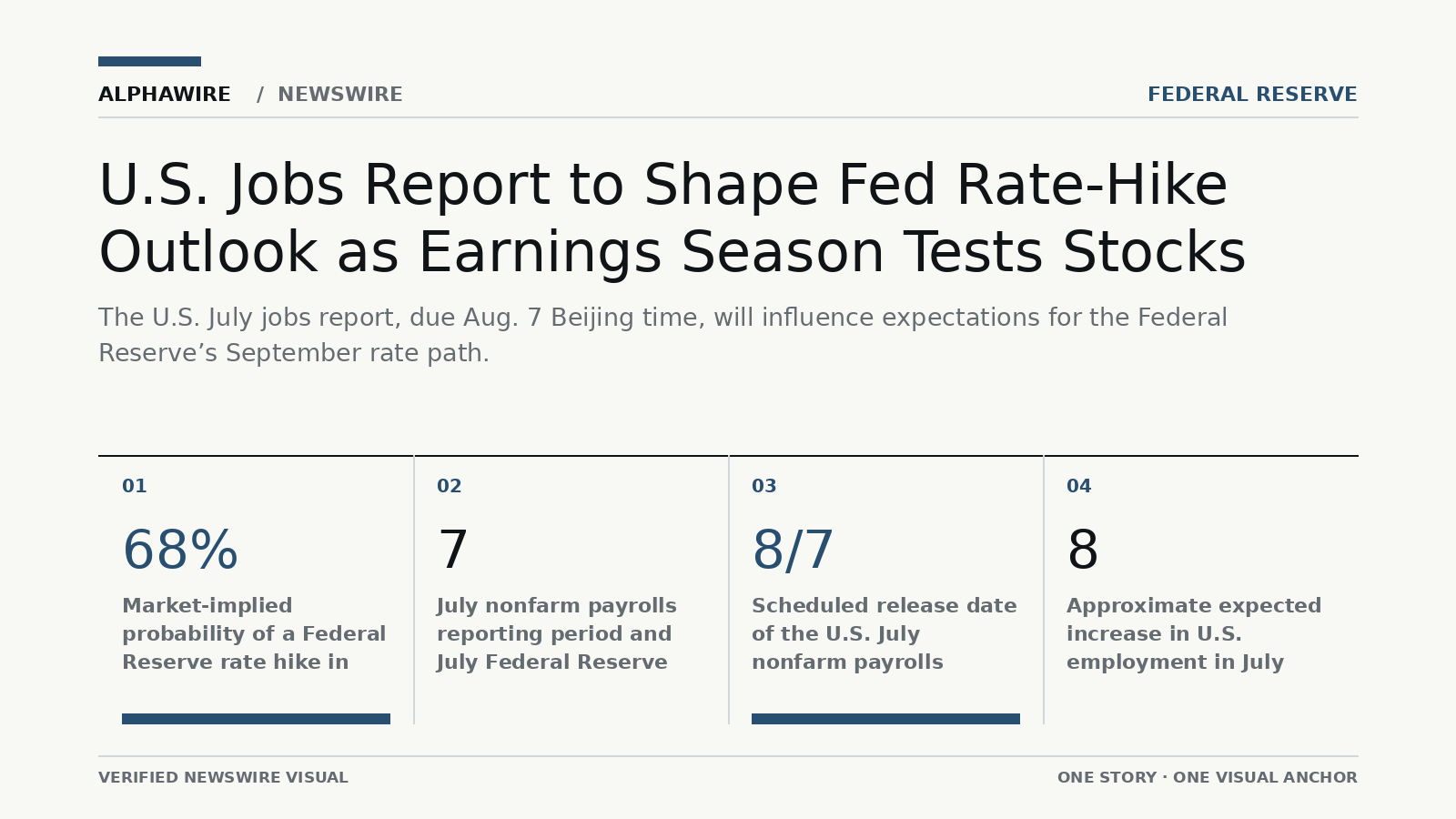
Upcoming U.S. economic data will influence the Federal Reserve’s assessment of rate hikes. After the Fed’s July policy meeting, the U.S. July nonfarm payrolls report is due this week and could have a significant impact on the central bank’s subsequent monetary-policy path. LSEG data show that the market now assigns a 68% probability to a Fed rate hike in September, down from fully pricing in such a move before this week’s rate decision. U.S. stocks also face the test of earnings season. Commercial-space company SpaceX, AI-chip company AMD, and storage companies SanDisk and Western Digital are all scheduled to report results this week. Goldman Sachs previously forecast that SanDisk’s fourth quarter of fiscal 2026 would be a “very strong quarter.” According to the schedule, the U.S. July nonfarm payrolls report will be released on Friday, Aug. 7, Beijing time. The payrolls data and unemployment rate will have a significant effect on market expectations for the Fed’s subsequent monetary-policy path. The report will be the first full employment reading since the Fed held rates steady at its July policy meeting. Its strength or weakness will determine market pricing for the September rate path. If July payroll growth continues to weaken, markets could undergo a larger dovish repricing. Economists surveyed expect U.S. employment to increase by around 80,000 jobs in July and project an unemployment rate of 4.3%. Before the payrolls report, several forward-looking employment indicators are due. The ADP employment report and initial jobless claims data are scheduled for Aug. 5 and Aug. 6, respectively, providing early signals ahead of the payrolls release. The ISM manufacturing report on Aug. 3 and the nonmanufacturing PMI on Aug. 5 will offer a broader view of economic conditions in July. If high oil prices persist, U.S. inflation readings could continue to rebound. The Fed may therefore maintain a restrictive stance in the short term, with its balance sheet focused primarily on maintaining stability in money markets. The U.S. Treasury will release its Quarterly Refunding Announcement, including estimates of borrowing needs, on Aug. 3. It will then issue its refinancing policy statement and specific Treasury auction schedule on Aug. 5. The recent sharp rise in Treasury yields could create resistance to any measures that increase the supply of longer-dated government debt. Analysts have said that the sharp rise in Treasury yields across maturities is the most important factor constraining the Treasury from expanding issuance of longer-term bonds and adjusting its forward issuance guidance. With long-term rates at levels not seen for decades, policymakers are expected to be cautious about any action that could push up the term premium and further increase borrowing costs.
U.S. stocks also face the test of earnings season. Commercial-space company SpaceX, AI-chip company AMD, and storage companies SanDisk and Western Digital are all scheduled to report results this week. Goldman Sachs previously forecast that SanDisk’s fourth quarter of fiscal 2026 would be a “very strong quarter.”
According to the schedule, the U.S. July nonfarm payrolls report will be released on Friday, Aug. 7, Beijing time. The payrolls data and unemployment rate will have a significant effect on market expectations for the Fed’s subsequent monetary-policy path.
The report will be the first full employment reading since the Fed held rates steady at its July policy meeting. Its strength or weakness will determine market pricing for the September rate path. If July payroll growth continues to weaken, markets could undergo a larger dovish repricing.
Economists surveyed expect U.S. employment to increase by around 80,000 jobs in July and project an unemployment rate of 4.3%.
Before the payrolls report, several forward-looking employment indicators are due. The ADP employment report and initial jobless claims data are scheduled for Aug. 5 and Aug. 6, respectively, providing early signals ahead of the payrolls release. The ISM manufacturing report on Aug. 3 and the nonmanufacturing PMI on Aug. 5 will offer a broader view of economic conditions in July.
If high oil prices persist, U.S. inflation readings could continue to rebound. The Fed may therefore maintain a restrictive stance in the short term, with its balance sheet focused primarily on maintaining stability in money markets.
The U.S. Treasury will release its Quarterly Refunding Announcement, including estimates of borrowing needs, on Aug. 3. It will then issue its refinancing policy statement and specific Treasury auction schedule on Aug. 5. The recent sharp rise in Treasury yields could create resistance to any measures that increase the supply of longer-dated government debt.
Analysts have said that the sharp rise in Treasury yields across maturities is the most important factor constraining the Treasury from expanding issuance of longer-term bonds and adjusting its forward issuance guidance. With long-term rates at levels not seen for decades, policymakers are expected to be cautious about any action that could push up the term premium and further increase borrowing costs.