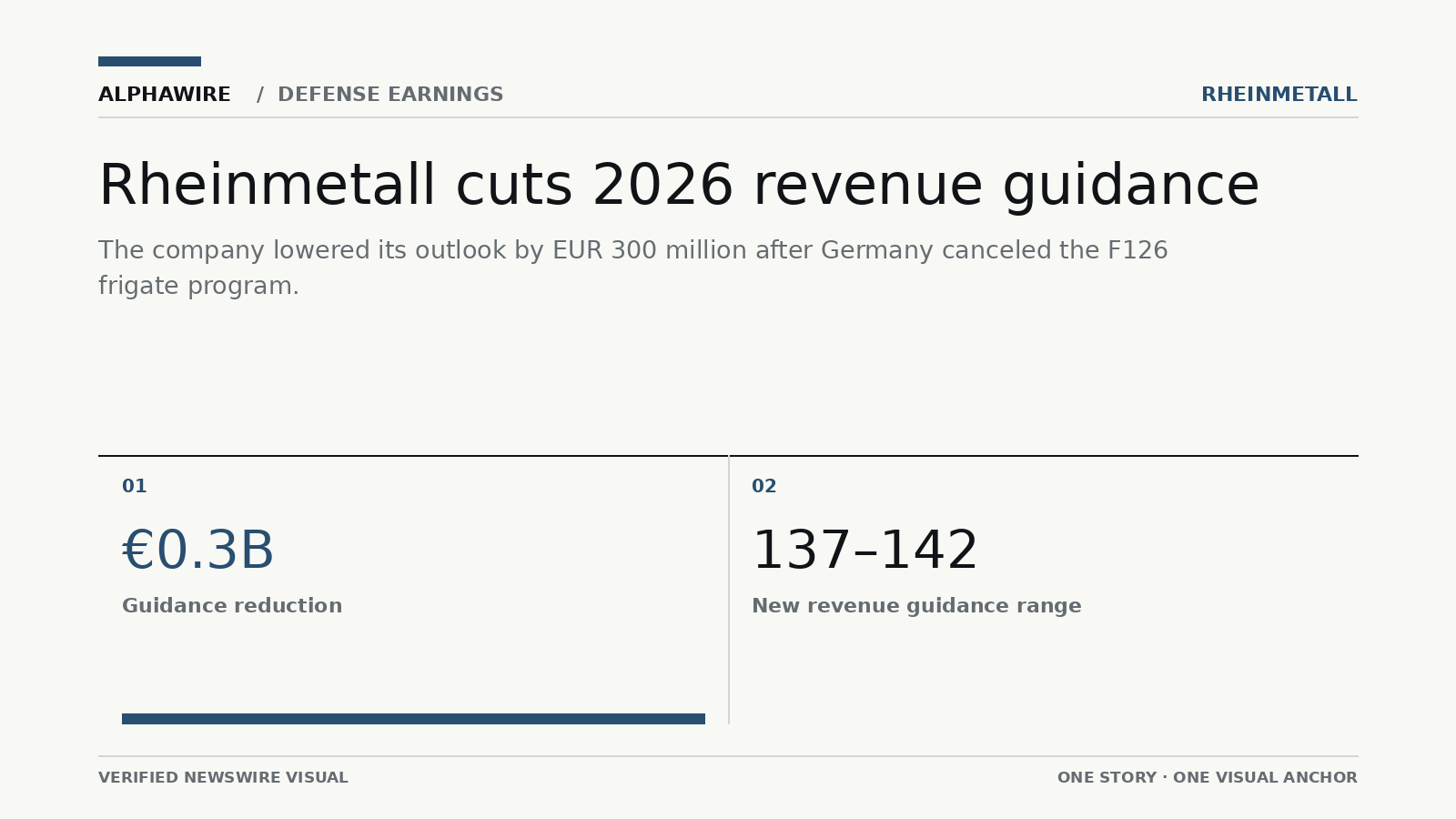
Rheinmetall cuts 2026 guidance after Germany cancels F 126 frigate program
Rheinmetall cut its 2026 full-year guidance by EUR 300 million after the German government canceled an order earlier this year. The company now expects full-year revenue of EUR 13.7 billion to EUR 14.2 billion. The defense contractor reported strong first-half results, with revenue up 39% year over year and profit up 74%. First-half revenue reached EUR 5.2 billion, driven by higher deliveries of military vehicles, ammunition and air-defense systems. Its newly acquired shipbuilding business contributed EUR 334 million in revenue. Chief Executive Armin Papperger said in a statement, “We achieved record growth and are steadily moving toward our annual targets.” Rheinmetall’s stock was volatile in Thursday morning trading. It initially fell about 3%, then recovered and was last up 1.4%. In March, Rheinmetall had forecast 2026 revenue growth of 40% to 45%. At the time, investors broadly expected the company to benefit as conflicts involving Ukraine and Iran prompted countries to replenish their ammunition stockpiles. Rheinmetall said it was well positioned to help the United States replenish its missile inventories. On Tuesday, Reuters cited anonymous sources as saying that the United States had nearly exhausted its stockpile of long-range precision missiles during the conflict with Iran. Since Russia’s full-scale invasion of Ukraine in 2022, Rheinmetall and other European defense companies have secured a surge of orders, driving their share prices higher. Rheinmetall has been one of the main beneficiaries of Germany’s increased defense spending. Its products include ammunition, missiles, heavy weapons, tanks and other land-based military equipment. Earlier this year, Rheinmetall completed its acquisition of the Lürssen shipyard, formally entering the naval-defense sector. The value of the transaction was not disclosed. Investors have become more cautious in recent months. Although defense companies continue to receive large numbers of orders, projects across the industry are often subject to delays and cost overruns, raising questions about whether current valuations have outpaced companies’ ability to deliver on that capacity. Rheinmetall’s shares have gained more than tenfold over the past five years, but they were down 25% for the year through Thursday’s opening. European peers including BAE Systems, Saab and Thales have followed similar trends. Germany formally canceled plans in June to purchase six F126 large frigates, sending a warning to the market. Rheinmetall had been expected to serve as the project’s prime contractor. The decision underscored that governments can change procurement plans at any time, shifting investor focus beyond a company’s ability to win orders toward its ability to execute and deliver them. When the cancellation was announced, Rheinmetall’s shares fell nearly 19% in a single session, while concern spread across the sector and weighed on other defense stocks. The report was published as part of a feature focused on second-quarter 2026 earnings for U.S.-listed stocks.
The defense contractor reported strong first-half results, with revenue up 39% year over year and profit up 74%. First-half revenue reached EUR 5.2 billion, driven by higher deliveries of military vehicles, ammunition and air-defense systems. Its newly acquired shipbuilding business contributed EUR 334 million in revenue.
Chief Executive Armin Papperger said in a statement, “We achieved record growth and are steadily moving toward our annual targets.”
Rheinmetall’s stock was volatile in Thursday morning trading. It initially fell about 3%, then recovered and was last up 1.4%.
In March, Rheinmetall had forecast 2026 revenue growth of 40% to 45%. At the time, investors broadly expected the company to benefit as conflicts involving Ukraine and Iran prompted countries to replenish their ammunition stockpiles. Rheinmetall said it was well positioned to help the United States replenish its missile inventories. On Tuesday, Reuters cited anonymous sources as saying that the United States had nearly exhausted its stockpile of long-range precision missiles during the conflict with Iran.
Since Russia’s full-scale invasion of Ukraine in 2022, Rheinmetall and other European defense companies have secured a surge of orders, driving their share prices higher. Rheinmetall has been one of the main beneficiaries of Germany’s increased defense spending. Its products include ammunition, missiles, heavy weapons, tanks and other land-based military equipment.
Earlier this year, Rheinmetall completed its acquisition of the Lürssen shipyard, formally entering the naval-defense sector. The value of the transaction was not disclosed.
Investors have become more cautious in recent months. Although defense companies continue to receive large numbers of orders, projects across the industry are often subject to delays and cost overruns, raising questions about whether current valuations have outpaced companies’ ability to deliver on that capacity.
Rheinmetall’s shares have gained more than tenfold over the past five years, but they were down 25% for the year through Thursday’s opening. European peers including BAE Systems, Saab and Thales have followed similar trends.
Germany formally canceled plans in June to purchase six F126 large frigates, sending a warning to the market. Rheinmetall had been expected to serve as the project’s prime contractor. The decision underscored that governments can change procurement plans at any time, shifting investor focus beyond a company’s ability to win orders toward its ability to execute and deliver them.
When the cancellation was announced, Rheinmetall’s shares fell nearly 19% in a single session, while concern spread across the sector and weighed on other defense stocks.
The report was published as part of a feature focused on second-quarter 2026 earnings for U.S.-listed stocks.