Black Rock TCP Capital to sell $523 million loan portfolio to shore up balance sheet
BlackRock TCP Capital Corp. plans to sell a $523 million private-credit investment portfolio to strengthen its balance sheet, reduce leverage and regain operating flexibility after mounting pressure on the publicly traded lending company. BlackRock TCP Capital is a business development company managed by BlackRock affiliates. It has sold a majority interest in a large pool of loan assets to Pantheon, a private-credit secondary-market investor, in an aggressive move to stabilize its investment portfolio. In a Thursday news release, BlackRock TCP Capital said the transaction would transfer a 95% equity interest in a continuation vehicle holding roughly $523 million of investment assets across 78 portfolio companies. Before the transaction, those assets represented about 48% of TCPC's debt-investment portfolio at fair value. Although BlackRock TCP Capital described the transaction as a portfolio repositioning, the move effectively amounts to a balance-sheet reset. Leverage is expected to fall from 1.38 times to 0.4 times, while the transaction will significantly increase liquidity as the private-credit market faces challenging conditions. The transaction also carries a cost. Based on the company's $6.58 net asset value per share as of June 30, BlackRock TCP Capital expects net asset value to decline by about 10.4%, or $0.68 per share. The deal highlights growing pressure on business development companies and private-credit firms. After years of rapid lending growth, investors are demanding stronger balance sheets from these institutions. BlackRock TCP Capital reported second-quarter net investment income of $18.1 million, or $0.22 per share. However, the company recorded $14.8 million in realized investment losses during the quarter, including a $10 million loss from its exit from AutoAlert. Net asset value per share fell to $6.58 at the end of June from $6.72 at the end of the first quarter. The company continues to hold several troubled investments. Nonaccrual investments represented 1.6% of the portfolio at fair value, down from 2.8% in the previous quarter. On a cost basis, however, the proportion remained 7.4%. Private-credit liquidity challenge The asset sale highlights a broader challenge facing private credit: Even when some loans continue to generate income, they can become difficult to manage when investors demand liquidity, leverage loses favor in the market or asset valuations come under pressure. The private-credit secondary market has emerged as one solution, allowing asset managers to move portfolios off their balance sheets without selling individual loans one by one. In BlackRock TCP Capital's case, the company will retain exposure to most of the portfolio companies by keeping its direct investment positions and a 5% equity interest in the continuation vehicle. However, transferring roughly two-thirds of each investment position will help reduce concentration risk and free up available capital. As it advances the transaction, BlackRock TCP Capital's board has hired investment bank Keefe, Bruyette & Woods to evaluate strategic alternatives. Those options include using additional leverage capacity, returning capital to shareholders through repurchases, pursuing a merger with another company or continuing to sell more portfolio assets. As BlackRock TCP Capital restructures, a growing number of investors are questioning whether private-credit portfolios are prepared for a market environment of persistently high interest rates, weaker borrower quality and slower asset exits.
BlackRock TCP Capital is a business development company managed by BlackRock affiliates. It has sold a majority interest in a large pool of loan assets to Pantheon, a private-credit secondary-market investor, in an aggressive move to stabilize its investment portfolio.
In a Thursday news release, BlackRock TCP Capital said the transaction would transfer a 95% equity interest in a continuation vehicle holding roughly $523 million of investment assets across 78 portfolio companies. Before the transaction, those assets represented about 48% of TCPC's debt-investment portfolio at fair value.
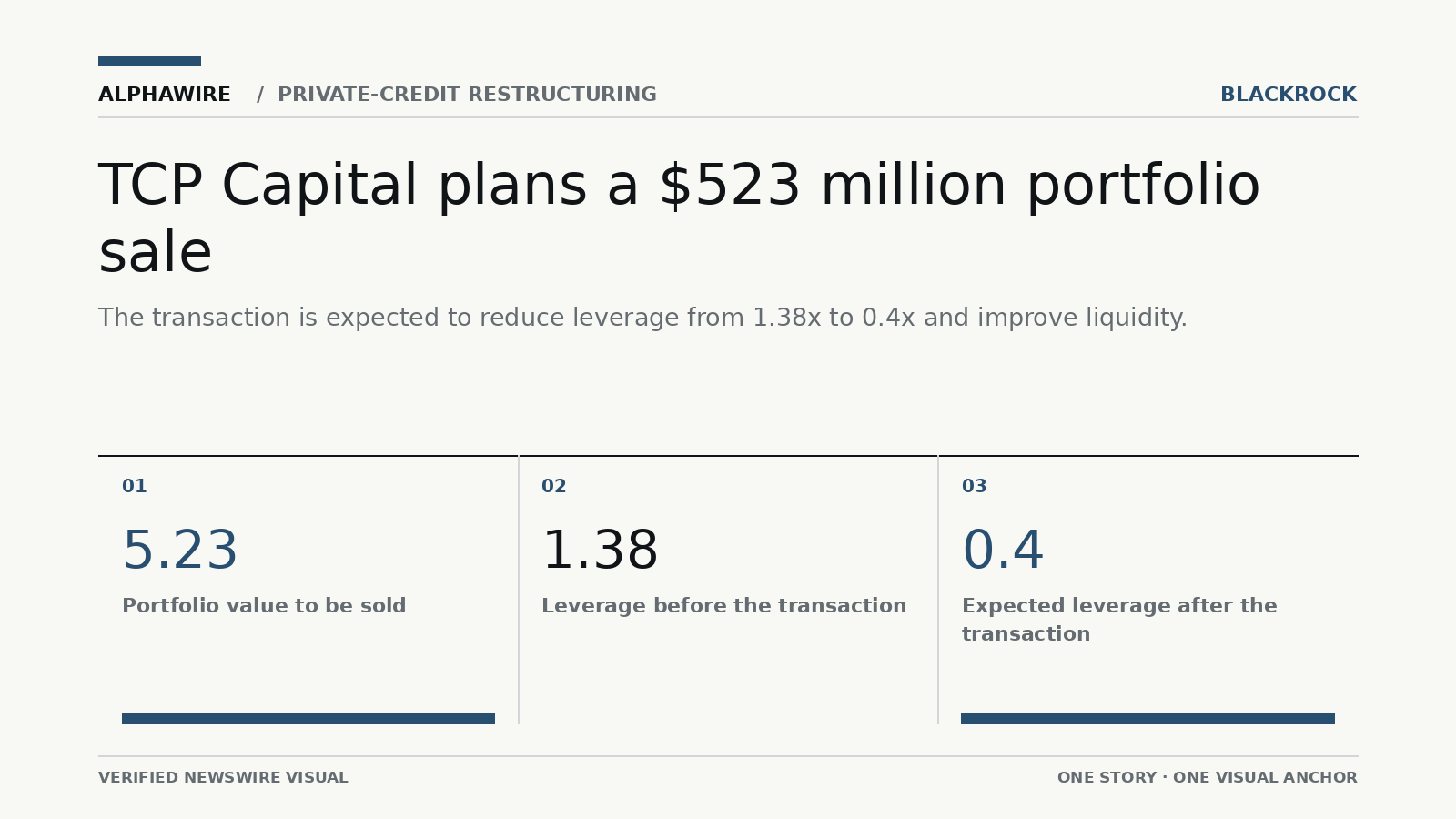
Although BlackRock TCP Capital described the transaction as a portfolio repositioning, the move effectively amounts to a balance-sheet reset. Leverage is expected to fall from 1.38 times to 0.4 times, while the transaction will significantly increase liquidity as the private-credit market faces challenging conditions.
The transaction also carries a cost. Based on the company's $6.58 net asset value per share as of June 30, BlackRock TCP Capital expects net asset value to decline by about 10.4%, or $0.68 per share.
The deal highlights growing pressure on business development companies and private-credit firms. After years of rapid lending growth, investors are demanding stronger balance sheets from these institutions.
BlackRock TCP Capital reported second-quarter net investment income of $18.1 million, or $0.22 per share. However, the company recorded $14.8 million in realized investment losses during the quarter, including a $10 million loss from its exit from AutoAlert.
Net asset value per share fell to $6.58 at the end of June from $6.72 at the end of the first quarter.
The company continues to hold several troubled investments. Nonaccrual investments represented 1.6% of the portfolio at fair value, down from 2.8% in the previous quarter. On a cost basis, however, the proportion remained 7.4%.
Private-credit liquidity challenge
The asset sale highlights a broader challenge facing private credit: Even when some loans continue to generate income, they can become difficult to manage when investors demand liquidity, leverage loses favor in the market or asset valuations come under pressure.
The private-credit secondary market has emerged as one solution, allowing asset managers to move portfolios off their balance sheets without selling individual loans one by one.
In BlackRock TCP Capital's case, the company will retain exposure to most of the portfolio companies by keeping its direct investment positions and a 5% equity interest in the continuation vehicle. However, transferring roughly two-thirds of each investment position will help reduce concentration risk and free up available capital.
As it advances the transaction, BlackRock TCP Capital's board has hired investment bank Keefe, Bruyette & Woods to evaluate strategic alternatives. Those options include using additional leverage capacity, returning capital to shareholders through repurchases, pursuing a merger with another company or continuing to sell more portfolio assets.
As BlackRock TCP Capital restructures, a growing number of investors are questioning whether private-credit portfolios are prepared for a market environment of persistently high interest rates, weaker borrower quality and slower asset exits.