CITIC Securities sees potential inflection in U.S. application-software revenue growth within 1-2 quarters
CITIC Securities said the “AI eating software” narrative is gradually being disproved. Leading vendors’ revenue and remaining performance obligations continue to grow steadily, and application-software fundamentals have not shown the structural slowdown that the market previously feared. At the same time, model providers are advancing enterprise adoption by embedding their products into existing workflows such as CRM, ERP, ITSM and HCM. Traditional software vendors’ data, industry knowledge and customer-service capabilities remain core competitive advantages. In the short term, the increasing commoditization of AI models and the rising share of AI-related revenue at software companies could support further valuation recovery across the U.S. software sector. Over the medium term, whether the sector can move from valuation recovery to a fundamental reversal will depend on whether AI products can lift companies’ overall revenue-growth rates. CITIC Securities said the next 1-2 quarters could be an important observation window. The report said the application-software sector’s July advance was driven by two factors: software vendors continued to post resilient operating results in the AI era, and deep cooperation between model providers and application vendors eased concerns that AI would replace software. From July 2026, the IGV software-sector index diverged from the Philadelphia Semiconductor Index, or SOX, and the Nasdaq-100 Index, or NDX. Citing Bloomberg, CITIC Securities said the application-software sector, which had been hit hardest by the “AI eating software” narrative, performed strongly in July. Major application-software companies generally gained more than 10% that month, while some rose more than 20%. With disagreements over the foundations of the AI industry continuing to surface, the market remains sharply divided over the sector’s outlook. CITIC Securities said the application-software sector has moved past the trading phase centered on the “AI eating software” narrative, which it described as inconsistent with basic logic and common sense. The market is beginning to recognize that traditional application-software vendors will continue to have a role in the AI era, and the frequency of irrational selling is expected to decline substantially. The sector could therefore see further valuation recovery. However, drawing a comparison with the 2010-2020 SaaS transformation, CITIC Securities said the durability of the sector’s next advance will depend on whether revenue growth accelerates. If revenue growth improves, the sector could enter a reversal phase. Given rising AI penetration, the report said the revenue-growth rates of major application-software companies could reach an inflection point within the next 1-2 quarters. On operating performance, Salesforce, SAP, ServiceNow and Workday continued to report revenue growth, while remaining performance obligations also expanded. Salesforce’s year-over-year revenue growth increased from 7.6% in FY2026 Q1 to 13.3% in FY2027 Q1, and its remaining performance obligations continued to grow in the double digits year over year. CITIC Securities said the stability of both revenue and orders indicates that industry growth is supported by customer renewals and business expansion, giving it a sustainable foundation for valuation recovery. The report also said that OpenAI and Anthropic’s commercial deployment of large models remains concentrated mainly in code development, developer tools and specialized lightweight workflows, rather than being deeply embedded in core enterprise processes such as CRM, ERP, ITSM and HCM. Model providers generally enter the enterprise market through integration with existing commercial-software ecosystems. According to company websites cited in the report, Salesforce and SAP have partnered with Anthropic to integrate Claude into their AI products, while ServiceNow and HubSpot have embedded GPT and Claude, respectively, into their business-process systems. CITIC Securities therefore views large models as an enhancement layer for enterprise software rather than a replacement layer, and said cooperation between model providers and application vendors has eased concerns that AI will replace software. Looking ahead, the report said that once concerns about AI replacing software are reduced, a rising share of AI-related revenue could further support valuation recovery for application-software companies. It again compared the current transition with the 2010-2020 SaaS transformation and said a sustained sector advance will depend on an improvement in revenue growth; if growth accelerates, the sector could enter a reversal phase. Based on company announcements, CITIC Securities estimated that AI revenue as a share of total revenue is continuing to rise at representative application-software companies. It said the forward price-to-earnings ratios for the next 12 months, based on Refinitiv consensus estimates, had fallen to 12.4 times, 13.7 times and 24.1 times for representative vendors. The report said continued growth in AI revenue contribution could support further valuation recovery. Its review of the global software industry’s SaaS transformation found that companies reached stock-price inflection points after their revenue growth accelerated. Based on companies’ revenue targets and the extent to which results have met those targets, as well as rising AI penetration, CITIC Securities said major application-software companies could see an inflection in revenue growth within the next 1-2 quarters. The report identified risks including volatility in IT spending and the macroeconomic environment; intensifying industry competition; slower-than-expected development of core AI technologies; continued tightening of technology-sector policy and regulation; regulatory risks related to private data; potential ethical, moral and user-privacy violations involving AI; and corporate data breaches and information-security incidents. CITIC Securities said the notion that AI will “eliminate software” remains largely a narrative without basic logical or common-sense support. The application-software sector’s July advance indicated that the market’s pessimistic view of U.S. software is gradually changing as AI’s contribution to revenue increases. The report said the application-software sector still has room for valuation recovery, but the durability of any subsequent advance will depend on whether revenue growth improves. If growth accelerates, the sector could enter a reversal phase. Considering macroeconomic expectations, AI progress and the gradual rise in AI revenue contribution, CITIC Securities said major application-software companies could see a revenue-growth inflection within the next 1-2 quarters. For the second half of 2026, the report highlighted leading application-software companies with strong balance sheets and platform characteristics, while focusing on whether traditional demand stabilizes and whether AI products can lift revenue growth. From a medium-term perspective, CITIC Securities said representative application-software vendors appear relatively attractive even under the strictest GAAP net-income measure.
In the short term, the increasing commoditization of AI models and the rising share of AI-related revenue at software companies could support further valuation recovery across the U.S. software sector. Over the medium term, whether the sector can move from valuation recovery to a fundamental reversal will depend on whether AI products can lift companies’ overall revenue-growth rates. CITIC Securities said the next 1-2 quarters could be an important observation window.
The report said the application-software sector’s July advance was driven by two factors: software vendors continued to post resilient operating results in the AI era, and deep cooperation between model providers and application vendors eased concerns that AI would replace software.
From July 2026, the IGV software-sector index diverged from the Philadelphia Semiconductor Index, or SOX, and the Nasdaq-100 Index, or NDX. Citing Bloomberg, CITIC Securities said the application-software sector, which had been hit hardest by the “AI eating software” narrative, performed strongly in July. Major application-software companies generally gained more than 10% that month, while some rose more than 20%. With disagreements over the foundations of the AI industry continuing to surface, the market remains sharply divided over the sector’s outlook.
CITIC Securities said the application-software sector has moved past the trading phase centered on the “AI eating software” narrative, which it described as inconsistent with basic logic and common sense. The market is beginning to recognize that traditional application-software vendors will continue to have a role in the AI era, and the frequency of irrational selling is expected to decline substantially. The sector could therefore see further valuation recovery.
However, drawing a comparison with the 2010-2020 SaaS transformation, CITIC Securities said the durability of the sector’s next advance will depend on whether revenue growth accelerates. If revenue growth improves, the sector could enter a reversal phase. Given rising AI penetration, the report said the revenue-growth rates of major application-software companies could reach an inflection point within the next 1-2 quarters.
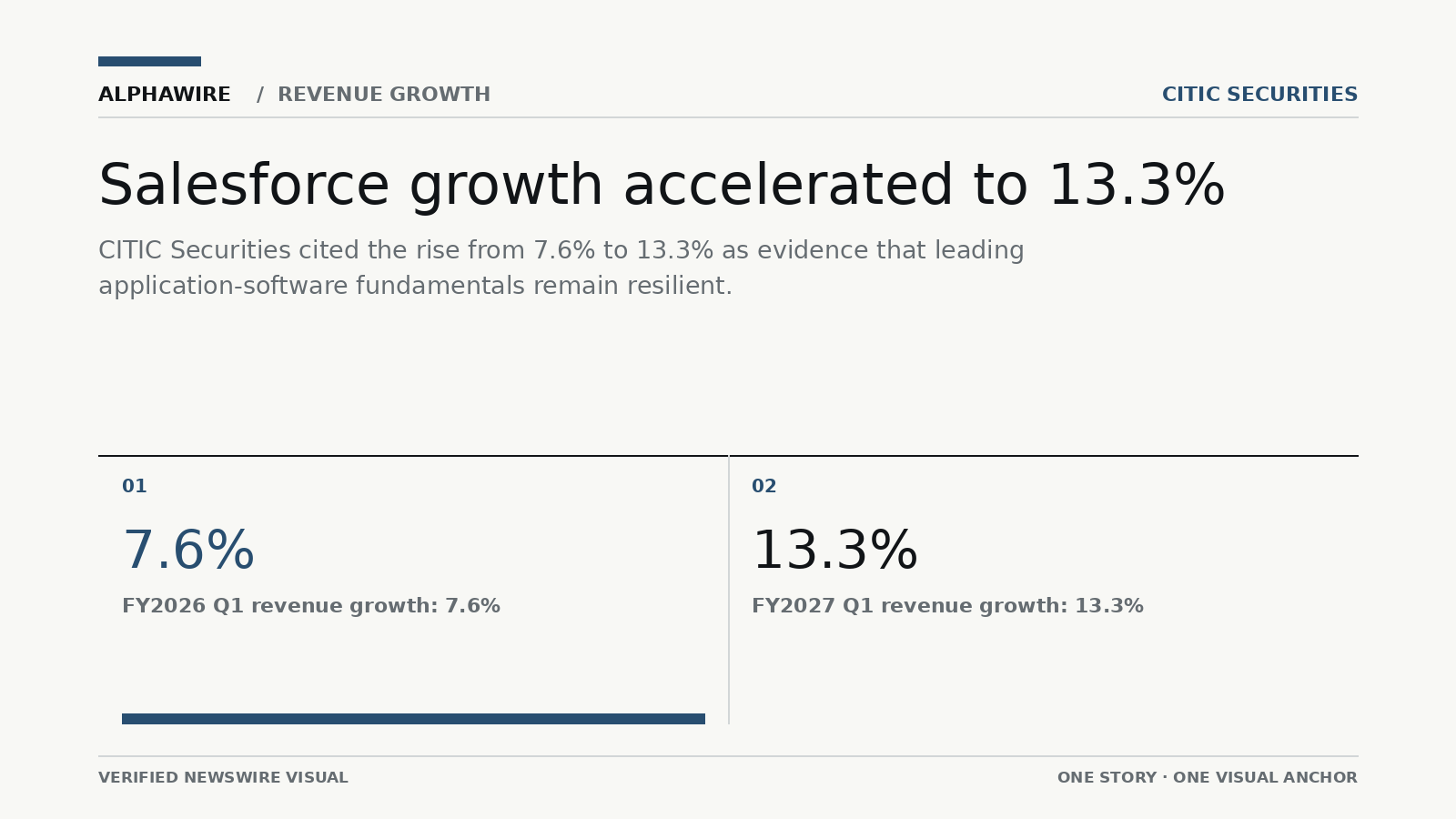
On operating performance, Salesforce, SAP, ServiceNow and Workday continued to report revenue growth, while remaining performance obligations also expanded. Salesforce’s year-over-year revenue growth increased from 7.6% in FY2026 Q1 to 13.3% in FY2027 Q1, and its remaining performance obligations continued to grow in the double digits year over year. CITIC Securities said the stability of both revenue and orders indicates that industry growth is supported by customer renewals and business expansion, giving it a sustainable foundation for valuation recovery.
The report also said that OpenAI and Anthropic’s commercial deployment of large models remains concentrated mainly in code development, developer tools and specialized lightweight workflows, rather than being deeply embedded in core enterprise processes such as CRM, ERP, ITSM and HCM. Model providers generally enter the enterprise market through integration with existing commercial-software ecosystems. According to company websites cited in the report, Salesforce and SAP have partnered with Anthropic to integrate Claude into their AI products, while ServiceNow and HubSpot have embedded GPT and Claude, respectively, into their business-process systems. CITIC Securities therefore views large models as an enhancement layer for enterprise software rather than a replacement layer, and said cooperation between model providers and application vendors has eased concerns that AI will replace software.
Looking ahead, the report said that once concerns about AI replacing software are reduced, a rising share of AI-related revenue could further support valuation recovery for application-software companies. It again compared the current transition with the 2010-2020 SaaS transformation and said a sustained sector advance will depend on an improvement in revenue growth; if growth accelerates, the sector could enter a reversal phase.
Based on company announcements, CITIC Securities estimated that AI revenue as a share of total revenue is continuing to rise at representative application-software companies. It said the forward price-to-earnings ratios for the next 12 months, based on Refinitiv consensus estimates, had fallen to 12.4 times, 13.7 times and 24.1 times for representative vendors. The report said continued growth in AI revenue contribution could support further valuation recovery. Its review of the global software industry’s SaaS transformation found that companies reached stock-price inflection points after their revenue growth accelerated. Based on companies’ revenue targets and the extent to which results have met those targets, as well as rising AI penetration, CITIC Securities said major application-software companies could see an inflection in revenue growth within the next 1-2 quarters.
The report identified risks including volatility in IT spending and the macroeconomic environment; intensifying industry competition; slower-than-expected development of core AI technologies; continued tightening of technology-sector policy and regulation; regulatory risks related to private data; potential ethical, moral and user-privacy violations involving AI; and corporate data breaches and information-security incidents.
CITIC Securities said the notion that AI will “eliminate software” remains largely a narrative without basic logical or common-sense support. The application-software sector’s July advance indicated that the market’s pessimistic view of U.S. software is gradually changing as AI’s contribution to revenue increases.
The report said the application-software sector still has room for valuation recovery, but the durability of any subsequent advance will depend on whether revenue growth improves. If growth accelerates, the sector could enter a reversal phase. Considering macroeconomic expectations, AI progress and the gradual rise in AI revenue contribution, CITIC Securities said major application-software companies could see a revenue-growth inflection within the next 1-2 quarters.
For the second half of 2026, the report highlighted leading application-software companies with strong balance sheets and platform characteristics, while focusing on whether traditional demand stabilizes and whether AI products can lift revenue growth. From a medium-term perspective, CITIC Securities said representative application-software vendors appear relatively attractive even under the strictest GAAP net-income measure.