HBO Max Drives Warner Bros. Discovery as Streaming Revenue Jumps 10%
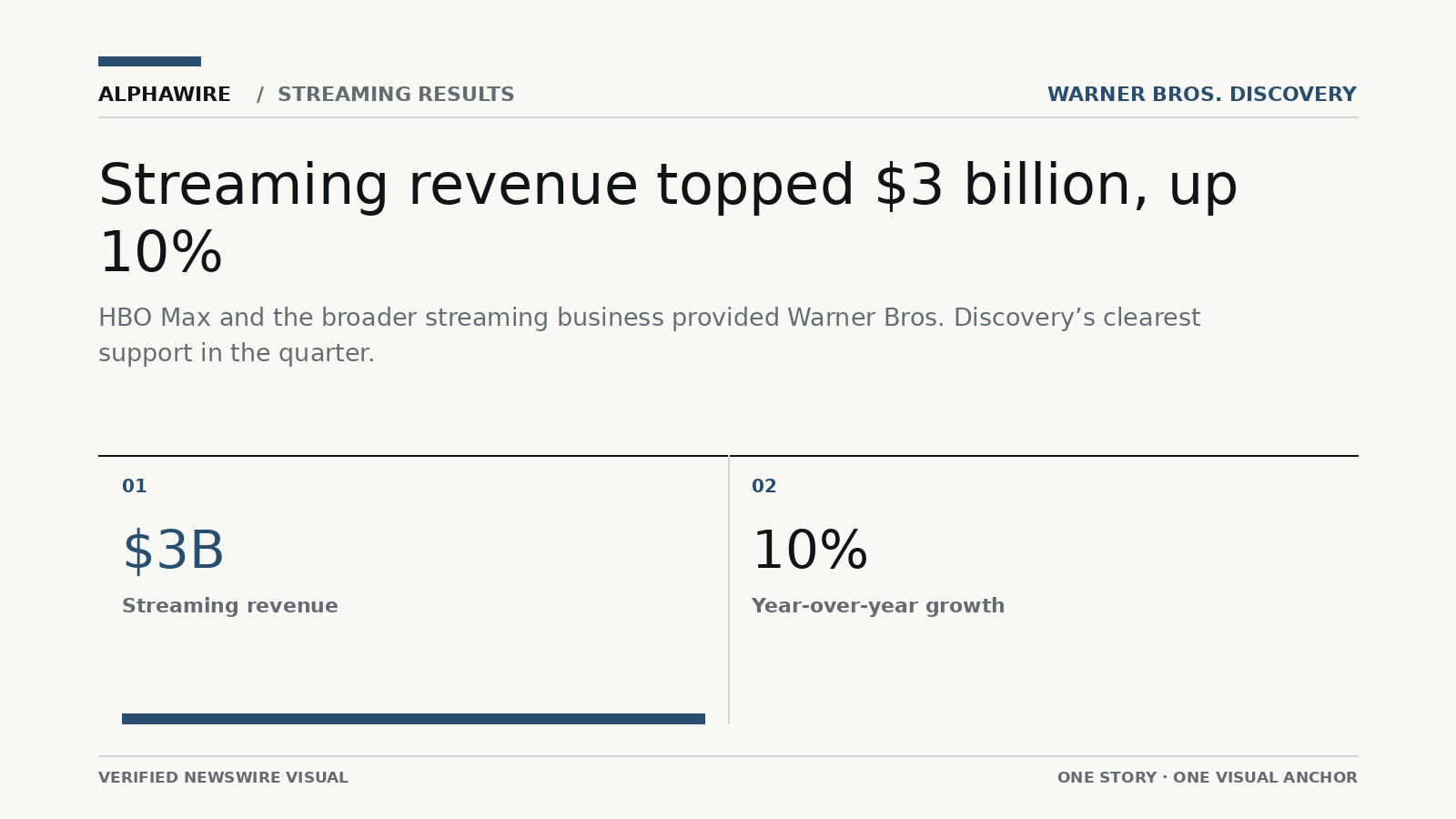
Warner Bros. Discovery reported second-quarter results Thursday, Aug. 6, with its streaming business emerging as the quarter’s biggest bright spot. Streaming revenue topped $3 billion, up 10% from a year earlier, while the proposed merger with Paramount Skydance faced additional scrutiny. Streaming became the company’s core growth engine. The segment generated more than $500 million in adjusted EBITDA. CEO David Zaslav said on the earnings call that, despite continued changes in how people consume entertainment, the company remains committed to the belief that “great creativity and quality storytelling are irreplaceable.” He said that HBO’s global reach, artistry and cultural impact were directly driving HBO Max’s financial progress. Growth came from expansion into new markets and contributions from shows including “Euphoria,” “House of the Dragon” and “The Pitt.” The company expects momentum to continue in the second half of the year, with major new content including “Harry Potter” and “The Gilded Age.” Zaslav said the company had successfully built HBO Max into a “highly valuable global streaming service.” The merger outlook remains uncertain. Paramount CEO David Ellison previously said that, after the acquisition closes, HBO Max and Paramount+ would be combined into a unified streaming service with roughly 200 million subscribers. He also said the HBO brand would not be weakened: “HBO should remain HBO.” The deal is currently being held up by a challenge from state attorneys general, with a trial scheduled for March 2027. The merger proposal has raised antitrust concerns, although both companies have said they need sufficient scale to compete with the industry’s largest players. Total revenue for the quarter was $8.72 billion, down 11% from a year earlier and below Wall Street’s $9.29 billion estimate. Net income attributable to the company fell sharply to $149 million, or 6 cents per share, from $1.58 billion, or 63 cents per share, in the year-earlier period. The decline was primarily driven by pre-acquisition intangible-asset adjustments and restructuring costs. Adjusted EBITDA was $1.88 billion, slightly below $1.95 billion a year earlier. CNN’s linear ratings also rose 24% from a year earlier, while viewing time across all platforms increased 19%. Zaslav said CNN’s quality and credibility had again been validated against a backdrop of geopolitical turmoil. Overall, strong streaming performance—particularly at HBO Max—provided important support for Warner Bros. Discovery. The legal and regulatory uncertainty surrounding the proposed merger, however, will remain a central focus in the period ahead.
Streaming became the company’s core growth engine. The segment generated more than $500 million in adjusted EBITDA. CEO David Zaslav said on the earnings call that, despite continued changes in how people consume entertainment, the company remains committed to the belief that “great creativity and quality storytelling are irreplaceable.” He said that HBO’s global reach, artistry and cultural impact were directly driving HBO Max’s financial progress.
Growth came from expansion into new markets and contributions from shows including “Euphoria,” “House of the Dragon” and “The Pitt.” The company expects momentum to continue in the second half of the year, with major new content including “Harry Potter” and “The Gilded Age.” Zaslav said the company had successfully built HBO Max into a “highly valuable global streaming service.”
The merger outlook remains uncertain. Paramount CEO David Ellison previously said that, after the acquisition closes, HBO Max and Paramount+ would be combined into a unified streaming service with roughly 200 million subscribers. He also said the HBO brand would not be weakened: “HBO should remain HBO.”
The deal is currently being held up by a challenge from state attorneys general, with a trial scheduled for March 2027. The merger proposal has raised antitrust concerns, although both companies have said they need sufficient scale to compete with the industry’s largest players.
Total revenue for the quarter was $8.72 billion, down 11% from a year earlier and below Wall Street’s $9.29 billion estimate. Net income attributable to the company fell sharply to $149 million, or 6 cents per share, from $1.58 billion, or 63 cents per share, in the year-earlier period. The decline was primarily driven by pre-acquisition intangible-asset adjustments and restructuring costs. Adjusted EBITDA was $1.88 billion, slightly below $1.95 billion a year earlier.
CNN’s linear ratings also rose 24% from a year earlier, while viewing time across all platforms increased 19%. Zaslav said CNN’s quality and credibility had again been validated against a backdrop of geopolitical turmoil.
Overall, strong streaming performance—particularly at HBO Max—provided important support for Warner Bros. Discovery. The legal and regulatory uncertainty surrounding the proposed merger, however, will remain a central focus in the period ahead.