Merck raises 2026 outlook as lab tools and chip demand lift results
Merck raised its full-year guidance for the second consecutive quarter after demand for laboratory tools and semiconductor-manufacturing materials boosted results in the latest quarter. The German company on Thursday raised its 2026 sales and underlying-earnings expectations for the group and all three of its business sectors: Life Science, Healthcare and Electronics. Merck said continued growth in demand for laboratory equipment and services, rare-disease drugs and materials drove second-quarter performance. Merck now expects full-year net sales of EUR 21 billion to EUR 21.8 billion, equivalent to USD 24.26 billion to USD 25.19 billion, with organic growth of 1% to 3%. It previously forecast flat sales or growth of no more than 3%, corresponding to revenue of EUR 20.4 billion to EUR 21.4 billion. The company expects earnings before interest, taxes, depreciation and amortization, excluding one-time items, of EUR 5.9 billion to EUR 6.3 billion, with growth of no more than 3%. Its previous forecast was EUR 5.7 billion to EUR 6.1 billion, with organic performance ranging from a 2% decline to 2% growth. Merck had already raised its full-year outlook when it reported first-quarter results. The company said the latest forecast reflects easing foreign-exchange headwinds and expectations for stronger demand in the Life Science and Electronics markets, while Healthcare remains resilient. "Our second-quarter performance confirms the continued momentum of important growth drivers across all the industries we serve," Chief Executive Beckmann said. Beckmann had been in the role for only a few weeks when the company in June completed its largest acquisition in more than a decade, buying U.S. life-science tools supplier Bio-Techne for USD 11 billion to strengthen its laboratory-equipment business. Merck reported second-quarter net sales of EUR 5.34 billion, up 4.1% organically, in line with the consensus forecast compiled by Vara Research. Organic growth was driven by the Electronics and Life Science sectors, which grew 12% and 8%, respectively. That offset a decline in Healthcare, where the multiple-sclerosis drug Mavenclad faced generic competition. Underlying EBITDA, excluding one-time items, rose 9.3% organically to EUR 1.6 billion, above the market expectation of EUR 1.53 billion. Merck's net profit fell to EUR 490 million from EUR 655 million, mainly because of higher research-and-development expenses and lower income from licensing transactions. The stock rose 1.4% in European midday trading and was up 20% year to date.
The German company on Thursday raised its 2026 sales and underlying-earnings expectations for the group and all three of its business sectors: Life Science, Healthcare and Electronics. Merck said continued growth in demand for laboratory equipment and services, rare-disease drugs and materials drove second-quarter performance.
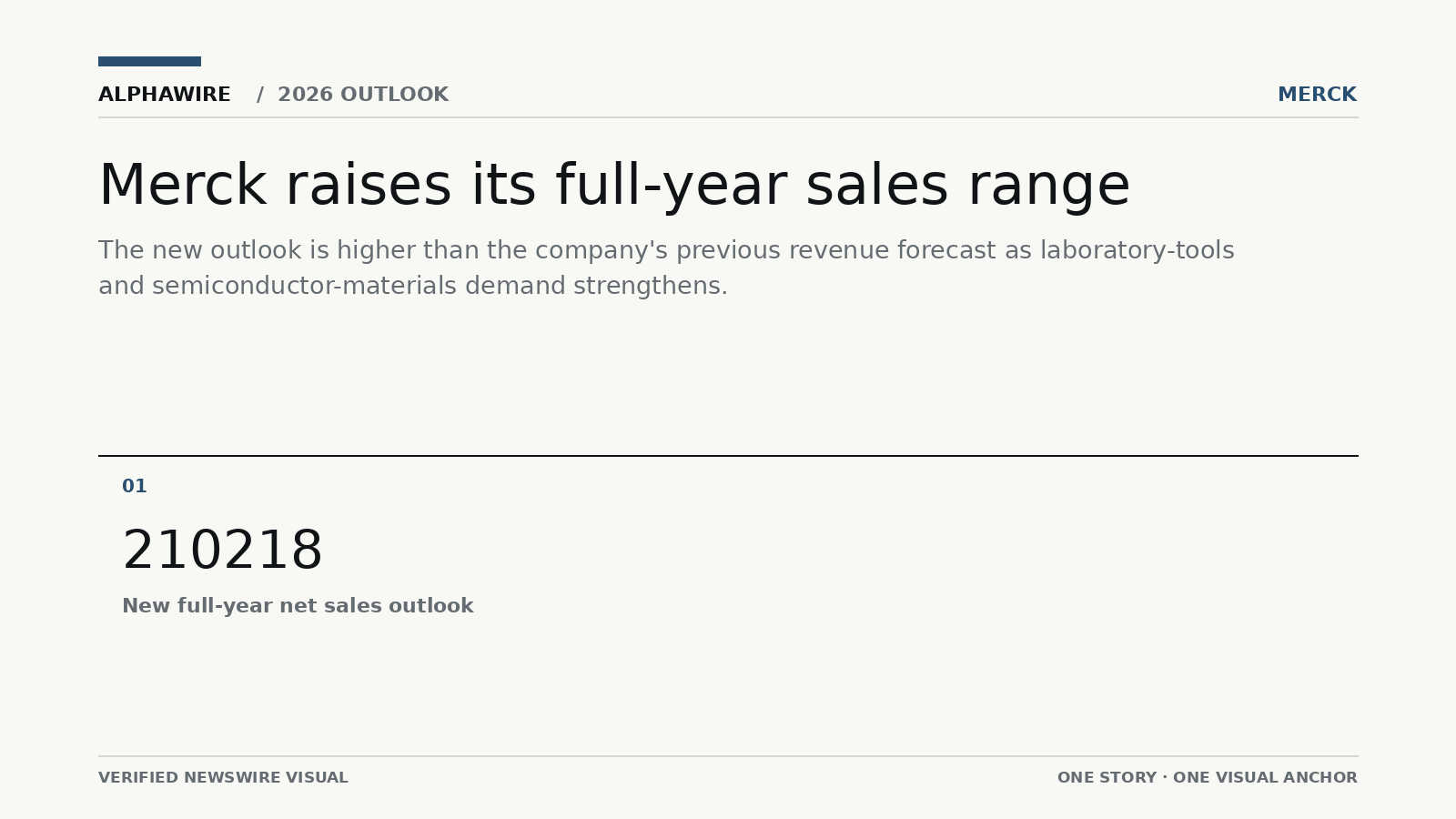
Merck now expects full-year net sales of EUR 21 billion to EUR 21.8 billion, equivalent to USD 24.26 billion to USD 25.19 billion, with organic growth of 1% to 3%. It previously forecast flat sales or growth of no more than 3%, corresponding to revenue of EUR 20.4 billion to EUR 21.4 billion.
The company expects earnings before interest, taxes, depreciation and amortization, excluding one-time items, of EUR 5.9 billion to EUR 6.3 billion, with growth of no more than 3%. Its previous forecast was EUR 5.7 billion to EUR 6.1 billion, with organic performance ranging from a 2% decline to 2% growth.
Merck had already raised its full-year outlook when it reported first-quarter results. The company said the latest forecast reflects easing foreign-exchange headwinds and expectations for stronger demand in the Life Science and Electronics markets, while Healthcare remains resilient.
"Our second-quarter performance confirms the continued momentum of important growth drivers across all the industries we serve," Chief Executive Beckmann said.
Beckmann had been in the role for only a few weeks when the company in June completed its largest acquisition in more than a decade, buying U.S. life-science tools supplier Bio-Techne for USD 11 billion to strengthen its laboratory-equipment business.
Merck reported second-quarter net sales of EUR 5.34 billion, up 4.1% organically, in line with the consensus forecast compiled by Vara Research.
Organic growth was driven by the Electronics and Life Science sectors, which grew 12% and 8%, respectively. That offset a decline in Healthcare, where the multiple-sclerosis drug Mavenclad faced generic competition.
Underlying EBITDA, excluding one-time items, rose 9.3% organically to EUR 1.6 billion, above the market expectation of EUR 1.53 billion.
Merck's net profit fell to EUR 490 million from EUR 655 million, mainly because of higher research-and-development expenses and lower income from licensing transactions.
The stock rose 1.4% in European midday trading and was up 20% year to date.