Wells Fargo says AI spending is benefiting ‘old economy’ stocks, not just chipmakers
Wells Fargo said the enormous AI spending by major technology companies is “trickling down into the broader economy,” potentially helping drive industrial stocks higher. Ohsung Kwon, a strategist at Wells Fargo, said he is confident that the growing number of data centers will benefit the industrial sector. In a report on Tuesday, he wrote that capital-goods companies producing the machinery, equipment and tools used to build data centers are currently the “biggest indirect beneficiaries of AI.” “The capital-goods sector has become the industry with the highest correlation to semiconductors in recent months,” Kwon said in an interview. He said several signs indicate that AI spending is spreading to industrial companies. Wells Fargo estimates that manufacturing activity expanded in July at its fastest pace in more than four years, while non-AI-related capital expenditures rose 10% from a year earlier and commercial and industrial loan growth accelerated significantly. Traders have increasingly favored so-called “old economy” sectors in recent months, driving a rotation in the leaders of the S&P 500 this year. The industrial sector has risen 20%, trailing only the energy and information technology sectors. Caterpillar, a maker of construction equipment, has been one beneficiary. Its shares surged on Tuesday as the data-center boom drove profit growth in the second quarter. Kwon estimates that about 40 hyperscale data centers are currently under construction in the United States, with more than 100 others in the planning stage. Most are concentrated in Texas, Georgia, Virginia and Pennsylvania. “We have seen regions with operating data centers reap the corresponding economic benefits. If this really becomes a new trend, then the impact of the trickle-down effect is still at a very, very early stage,” Kwon said. Data-center construction in the United States is also facing increasing opposition. Residents are concerned that building data centers near communities could affect energy costs and water supplies. “I think the biggest risk facing data-center construction is political opposition, especially as the November midterm elections approach,” Kwon said. Goldman Sachs also recently said that the rotation of capital has lifted the valuations of many “old economy” industries that the market had previously overlooked. Industrial stocks are now valued above their range over the past 20 years, while technology stocks have returned to their 20-year average level.
Ohsung Kwon, a strategist at Wells Fargo, said he is confident that the growing number of data centers will benefit the industrial sector. In a report on Tuesday, he wrote that capital-goods companies producing the machinery, equipment and tools used to build data centers are currently the “biggest indirect beneficiaries of AI.”
“The capital-goods sector has become the industry with the highest correlation to semiconductors in recent months,” Kwon said in an interview.
He said several signs indicate that AI spending is spreading to industrial companies. Wells Fargo estimates that manufacturing activity expanded in July at its fastest pace in more than four years, while non-AI-related capital expenditures rose 10% from a year earlier and commercial and industrial loan growth accelerated significantly.
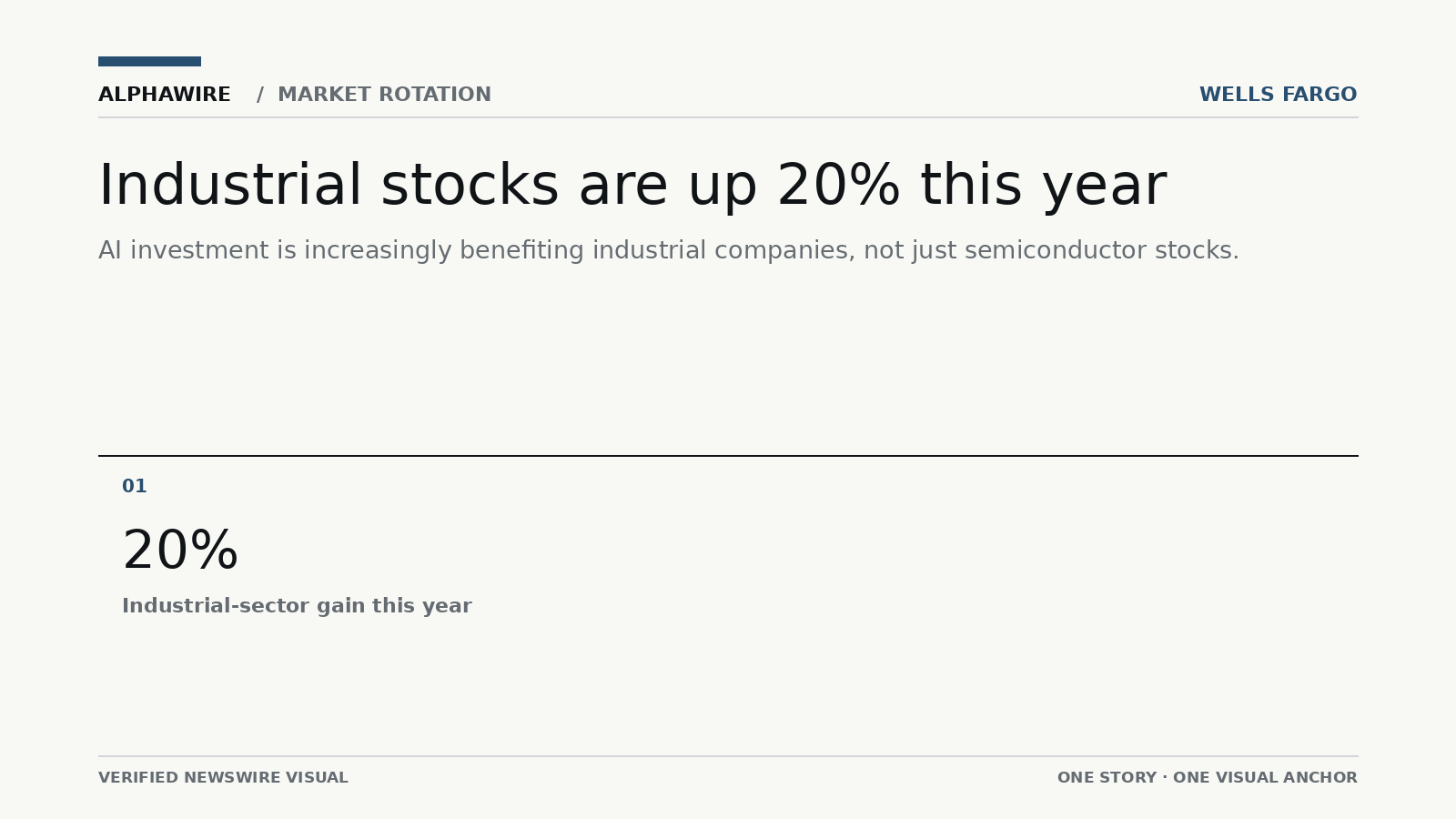
Traders have increasingly favored so-called “old economy” sectors in recent months, driving a rotation in the leaders of the S&P 500 this year. The industrial sector has risen 20%, trailing only the energy and information technology sectors.
Caterpillar, a maker of construction equipment, has been one beneficiary. Its shares surged on Tuesday as the data-center boom drove profit growth in the second quarter.
Kwon estimates that about 40 hyperscale data centers are currently under construction in the United States, with more than 100 others in the planning stage. Most are concentrated in Texas, Georgia, Virginia and Pennsylvania.
“We have seen regions with operating data centers reap the corresponding economic benefits. If this really becomes a new trend, then the impact of the trickle-down effect is still at a very, very early stage,” Kwon said.
Data-center construction in the United States is also facing increasing opposition. Residents are concerned that building data centers near communities could affect energy costs and water supplies.
“I think the biggest risk facing data-center construction is political opposition, especially as the November midterm elections approach,” Kwon said.
Goldman Sachs also recently said that the rotation of capital has lifted the valuations of many “old economy” industries that the market had previously overlooked. Industrial stocks are now valued above their range over the past 20 years, while technology stocks have returned to their 20-year average level.