Google’s AI Shake-Up Raises Questions About Pichai’s Succession Planning
As companies including Dada Takeaway and Shopify released second-quarter earnings, Google on Thursday announced a major leadership shake-up. AI leader and Google DeepMind CEO Demis Hassabis was promoted to chairman of the AI unit and appointed chief scientist of Google parent Alphabet. The company also disclosed that several DeepMind executives, including Chief Scientist Jeff Dean, would leave to start a new company. Some market observers viewed the changes as negative, and Google’s stock fell 4%. The practical impact of the personnel changes is limited. Hassabis was not responsible for DeepMind’s day-to-day operations; real operating authority had been held by DeepMind Chief Technology Officer Koray Kavukcuoglu, who is now formally taking over Google DeepMind. Hassabis is DeepMind’s public standard-bearer and a leading scientist with a broad, forward-looking perspective, and he will continue in that role. He is also a Nobel Prize winner. My colleague Eileen Wu learned that Google employees generally believe that, although they continue to hold Jeff Dean in high regard, his core influence over the Gemini large-language-model project has already declined. The central question raised by the shake-up is whether it will change the list of potential successors to Sundar Pichai, the dual CEO of Google and Alphabet. Many veteran observers have long included Hassabis among the candidates. Thomas Kurian, head of Google Cloud, is also considered a contender. If Hassabis is more interested in scientific research than in running a business division, he is unlikely to seek the Alphabet CEO role. He will also continue to lead Isomorphic Labs, Alphabet’s drug-discovery research organization, reinforcing the view that he prefers to focus on research. In other words, the changes improve Kurian’s prospects as a potential successor. Pichai’s successor does not need to be chosen anytime soon. His position is currently secure. Investors have recently questioned Google’s aggressive capital-spending plans, and the market has continued to raise various concerns about the company’s next-generation AI models, but those are short-term disputes. Over the longer term, Pichai has answered those doubts with results, demonstrating that Google can lead in AI, easing concerns that the AI business could undermine search, the company’s core cash-generating business, and overseeing rapid growth in Google Cloud. Pichai is just past 50 and could remain in charge of the company for many more years. Corporate boards, however, must always maintain a pipeline of potential successors. Some argue that, given Google’s enormous scale, the group CEO may not need to handle every aspect of day-to-day operations, meaning Hassabis could still remain a candidate. A CEO’s core mission is to set long-term strategy and ensure the company’s continued development. But the role inevitably involves complex operating decisions and many difficult, unpopular matters. Pichai’s appearance at a congressional hearing several years ago is one example. As Pichai said today in describing Hassabis, Hassabis wants to “actively shape the future of artificial intelligence.” For someone with that ambition, the group CEO role may not be his ultimate destination. Compared with running a company, he may be more interested in pursuing a second Nobel Prize. Figma’s Growth Cools, Pressuring Its Stock Figma’s stock fell 15% in after-hours trading Wednesday after the design-software company warned that third-quarter revenue growth would slow sharply, its operating margin would decline and two senior executives would soon leave. Figma’s second-quarter revenue growth was 48%, up 2 percentage points from the first quarter. But the company forecast that growth would slow to 36% in the third quarter. That pace remains substantial, but the 12-percentage-point decline is difficult to ignore, particularly as AI-powered competitors continue to emerge and AI giants such as Anthropic enter the sector. Figma also expects its full-year operating margin to be just 9%, compared with a 13% margin in the first six months of the year. The company attributed the margin decline primarily to increased investment. Its teams are developing several new products that remain in testing and are not yet being sold to customers. The products will be broadly launched after they mature. That explanation did not persuade investors in the capital markets.
The practical impact of the personnel changes is limited. Hassabis was not responsible for DeepMind’s day-to-day operations; real operating authority had been held by DeepMind Chief Technology Officer Koray Kavukcuoglu, who is now formally taking over Google DeepMind. Hassabis is DeepMind’s public standard-bearer and a leading scientist with a broad, forward-looking perspective, and he will continue in that role. He is also a Nobel Prize winner. My colleague Eileen Wu learned that Google employees generally believe that, although they continue to hold Jeff Dean in high regard, his core influence over the Gemini large-language-model project has already declined.
The central question raised by the shake-up is whether it will change the list of potential successors to Sundar Pichai, the dual CEO of Google and Alphabet. Many veteran observers have long included Hassabis among the candidates. Thomas Kurian, head of Google Cloud, is also considered a contender.
If Hassabis is more interested in scientific research than in running a business division, he is unlikely to seek the Alphabet CEO role. He will also continue to lead Isomorphic Labs, Alphabet’s drug-discovery research organization, reinforcing the view that he prefers to focus on research. In other words, the changes improve Kurian’s prospects as a potential successor.
Pichai’s successor does not need to be chosen anytime soon. His position is currently secure. Investors have recently questioned Google’s aggressive capital-spending plans, and the market has continued to raise various concerns about the company’s next-generation AI models, but those are short-term disputes.
Over the longer term, Pichai has answered those doubts with results, demonstrating that Google can lead in AI, easing concerns that the AI business could undermine search, the company’s core cash-generating business, and overseeing rapid growth in Google Cloud. Pichai is just past 50 and could remain in charge of the company for many more years.
Corporate boards, however, must always maintain a pipeline of potential successors. Some argue that, given Google’s enormous scale, the group CEO may not need to handle every aspect of day-to-day operations, meaning Hassabis could still remain a candidate. A CEO’s core mission is to set long-term strategy and ensure the company’s continued development.
But the role inevitably involves complex operating decisions and many difficult, unpopular matters. Pichai’s appearance at a congressional hearing several years ago is one example. As Pichai said today in describing Hassabis, Hassabis wants to “actively shape the future of artificial intelligence.” For someone with that ambition, the group CEO role may not be his ultimate destination. Compared with running a company, he may be more interested in pursuing a second Nobel Prize.
Figma’s Growth Cools, Pressuring Its Stock
Figma’s stock fell 15% in after-hours trading Wednesday after the design-software company warned that third-quarter revenue growth would slow sharply, its operating margin would decline and two senior executives would soon leave.
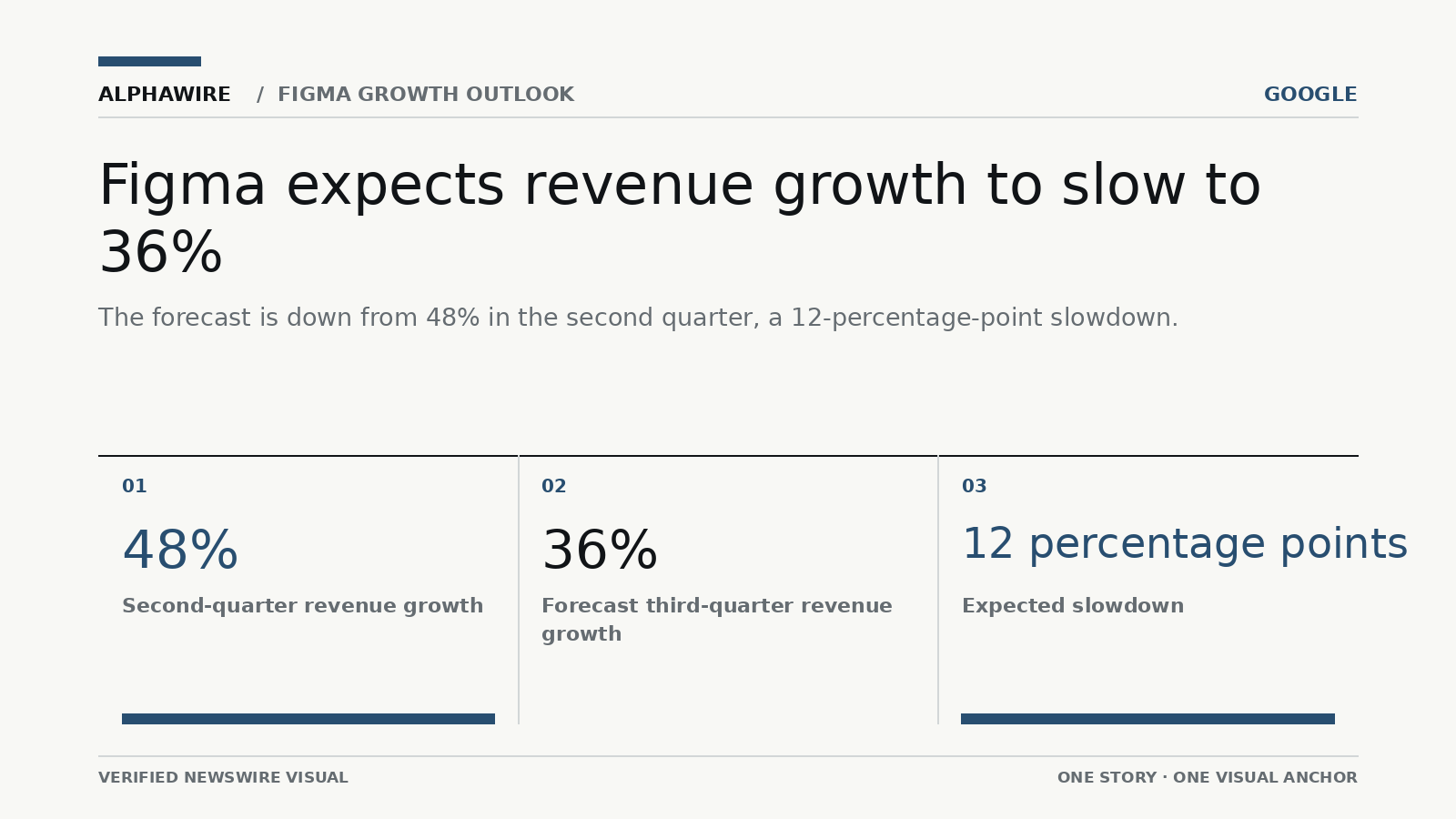
Figma’s second-quarter revenue growth was 48%, up 2 percentage points from the first quarter. But the company forecast that growth would slow to 36% in the third quarter. That pace remains substantial, but the 12-percentage-point decline is difficult to ignore, particularly as AI-powered competitors continue to emerge and AI giants such as Anthropic enter the sector.
Figma also expects its full-year operating margin to be just 9%, compared with a 13% margin in the first six months of the year.
The company attributed the margin decline primarily to increased investment. Its teams are developing several new products that remain in testing and are not yet being sold to customers. The products will be broadly launched after they mature. That explanation did not persuade investors in the capital markets.