Berkshire Hathaway shares rise as investors warm to Greg Abel’s leadership
Berkshire Hathaway shares are recovering as investors increasingly accept Greg Abel’s leadership, following a wave of concern over Warren Buffett’s planned departure as chief executive. The stock has reached its highest level since Buffett announced his retirement in May 2025. Yahoo Finance AlphaSpace data shows Berkshire shares have gained 3.7% over the past month. The immediate catalyst has been a rotation of capital back into widely regarded defensive assets as technology stocks weaken. Berkshire owns a broad range of businesses with relatively stable operations, including GEICO, BNSF Railway, utilities and industrial manufacturing operations. Despite the recent recovery, Berkshire is up just 4% this year, significantly trailing the S&P 500’s 12.6% gain. Investors are still waiting to see whether the company will deploy more aggressively its cash reserve of more than $300 billion. At Berkshire’s annual shareholder meeting in Omaha, Nebraska, on May 3, 2025, Buffett announced that he planned to step down as chief executive at the end of that year and transfer management responsibility to Abel, an internal executive. The announcement came near the end of a roughly five-hour shareholder question-and-answer session and surprised the audience. Buffett said the only board members who knew in advance were his two children, Howard Buffett and Susie Buffett. Buffett formally stepped down as Berkshire’s chief executive on Jan. 1, 2026, but continued as the company’s chairman. The most recent Berkshire shareholder meeting marked the start of a new era. For the first time in 60 years, Buffett was no longer the unquestioned central figure onstage. The “Oracle of Omaha” sat in the front row, a highly symbolic gesture that publicly endorsed Abel’s succession, while Abel took the stage and led the meeting. The meeting retained its customary relaxed atmosphere. In the opening ceremony, Abel humorously “retired” a jersey bearing the number 60 in tribute to Buffett’s 60-year tenure at the helm. The event also featured a cautionary, entertaining AI deepfake video in which an AI-generated Buffett asked Abel why investors should hold Berkshire shares for the long term. Investors and analysts broadly viewed Abel’s first meeting as the sole leader as operationally steady, although his style differs considerably from Buffett’s signature plainspoken and approachable manner. Investors have also begun assessing more rationally companies such as Berkshire, which have relatively little exposure to the AI sector and generally stable performance. At the same time, the market is gradually accepting the reality that Buffett will not return as chief executive.
Yahoo Finance AlphaSpace data shows Berkshire shares have gained 3.7% over the past month. The immediate catalyst has been a rotation of capital back into widely regarded defensive assets as technology stocks weaken.
Berkshire owns a broad range of businesses with relatively stable operations, including GEICO, BNSF Railway, utilities and industrial manufacturing operations.
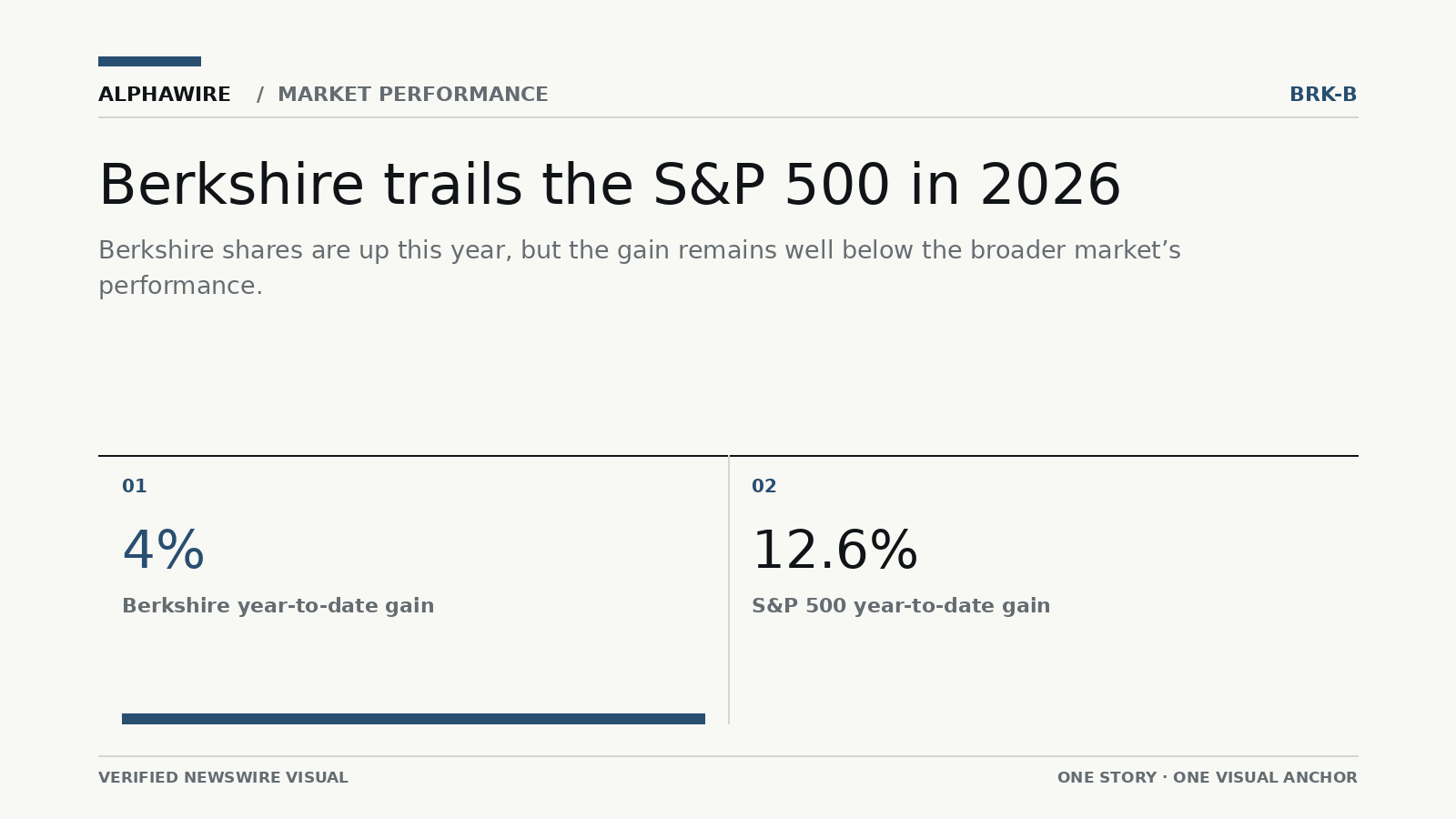
Despite the recent recovery, Berkshire is up just 4% this year, significantly trailing the S&P 500’s 12.6% gain. Investors are still waiting to see whether the company will deploy more aggressively its cash reserve of more than $300 billion.
At Berkshire’s annual shareholder meeting in Omaha, Nebraska, on May 3, 2025, Buffett announced that he planned to step down as chief executive at the end of that year and transfer management responsibility to Abel, an internal executive.
The announcement came near the end of a roughly five-hour shareholder question-and-answer session and surprised the audience. Buffett said the only board members who knew in advance were his two children, Howard Buffett and Susie Buffett.
Buffett formally stepped down as Berkshire’s chief executive on Jan. 1, 2026, but continued as the company’s chairman.
The most recent Berkshire shareholder meeting marked the start of a new era. For the first time in 60 years, Buffett was no longer the unquestioned central figure onstage. The “Oracle of Omaha” sat in the front row, a highly symbolic gesture that publicly endorsed Abel’s succession, while Abel took the stage and led the meeting.
The meeting retained its customary relaxed atmosphere. In the opening ceremony, Abel humorously “retired” a jersey bearing the number 60 in tribute to Buffett’s 60-year tenure at the helm. The event also featured a cautionary, entertaining AI deepfake video in which an AI-generated Buffett asked Abel why investors should hold Berkshire shares for the long term.
Investors and analysts broadly viewed Abel’s first meeting as the sole leader as operationally steady, although his style differs considerably from Buffett’s signature plainspoken and approachable manner.
Investors have also begun assessing more rationally companies such as Berkshire, which have relatively little exposure to the AI sector and generally stable performance. At the same time, the market is gradually accepting the reality that Buffett will not return as chief executive.