S&P 500 Posts Best Weekly Gain Since April as Weaker Jobs Data Eases Rate-Hike Pressure
U.S. stocks closed higher Friday after employment data showed that nonfarm payrolls unexpectedly declined in July, potentially prompting the Federal Reserve to delay interest-rate increases. The S&P 500 set another record and posted its best weekly performance since April. The technology-heavy Nasdaq 100 rose 1.2%, while the Philadelphia Semiconductor Index gained 3%. Data released Friday by the U.S. Bureau of Labor Statistics showed that nonfarm payrolls fell by 23,000 in July, while figures for the previous two months were also revised sharply lower. The unemployment rate declined to 4.1% as the labor-force participation rate fell. The data suggested that the labor market may be starting to weaken, even though resilient consumer demand continues to encourage some employers to move forward with hiring plans. The market is also being affected by higher prices and uncertainty related to the war in Iran. Brent Wilsey, chief investment officer at Wilsey Asset Management, said: “Although one weak jobs report is unlikely to determine the Federal Reserve’s policy direction, we believe the Fed will continue to stay on hold with interest rates and give itself more time to assess the economic data released in the coming months.” The president of the Federal Reserve Bank of Richmond said the U.S. labor market appeared to be in a “weak equilibrium,” extending the low-hiring environment of the past year. In the Middle East, Iran’s government was reportedly debating the wording of a proposed agreement with Oman involving the Strait of Hormuz. Citing a U.S. official, a report said the United States would lift its naval blockade of Iranian ports once an agreement between Oman and Iran to restore commercial shipping was announced. Joe Gilbert, a portfolio manager at Integrity Asset Management, said: “As progress on an agreement involving the Strait of Hormuz appeared increasingly likely and the rise in interest rates partially cooled, investors returned to the technology stocks that had led the market previously.” Coherent shares surged Friday. Microchip Technology also rose after issuing better-than-expected second-quarter guidance. At the close, the S&P 500 rose 0.6% to 7,757.64; the Dow Jones Industrial Average gained 0.3% to 54,036.93; the Nasdaq Composite advanced 1.3% to 26,690.62; the Nasdaq 100 climbed 1.2% to 29,722.3; and the Russell 2000 increased 1.1% to 3,034.494.
The S&P 500 set another record and posted its best weekly performance since April. The technology-heavy Nasdaq 100 rose 1.2%, while the Philadelphia Semiconductor Index gained 3%.
Data released Friday by the U.S. Bureau of Labor Statistics showed that nonfarm payrolls fell by 23,000 in July, while figures for the previous two months were also revised sharply lower. The unemployment rate declined to 4.1% as the labor-force participation rate fell.
The data suggested that the labor market may be starting to weaken, even though resilient consumer demand continues to encourage some employers to move forward with hiring plans. The market is also being affected by higher prices and uncertainty related to the war in Iran.
Brent Wilsey, chief investment officer at Wilsey Asset Management, said: “Although one weak jobs report is unlikely to determine the Federal Reserve’s policy direction, we believe the Fed will continue to stay on hold with interest rates and give itself more time to assess the economic data released in the coming months.”
The president of the Federal Reserve Bank of Richmond said the U.S. labor market appeared to be in a “weak equilibrium,” extending the low-hiring environment of the past year.
In the Middle East, Iran’s government was reportedly debating the wording of a proposed agreement with Oman involving the Strait of Hormuz. Citing a U.S. official, a report said the United States would lift its naval blockade of Iranian ports once an agreement between Oman and Iran to restore commercial shipping was announced.
Joe Gilbert, a portfolio manager at Integrity Asset Management, said: “As progress on an agreement involving the Strait of Hormuz appeared increasingly likely and the rise in interest rates partially cooled, investors returned to the technology stocks that had led the market previously.”
Coherent shares surged Friday. Microchip Technology also rose after issuing better-than-expected second-quarter guidance.
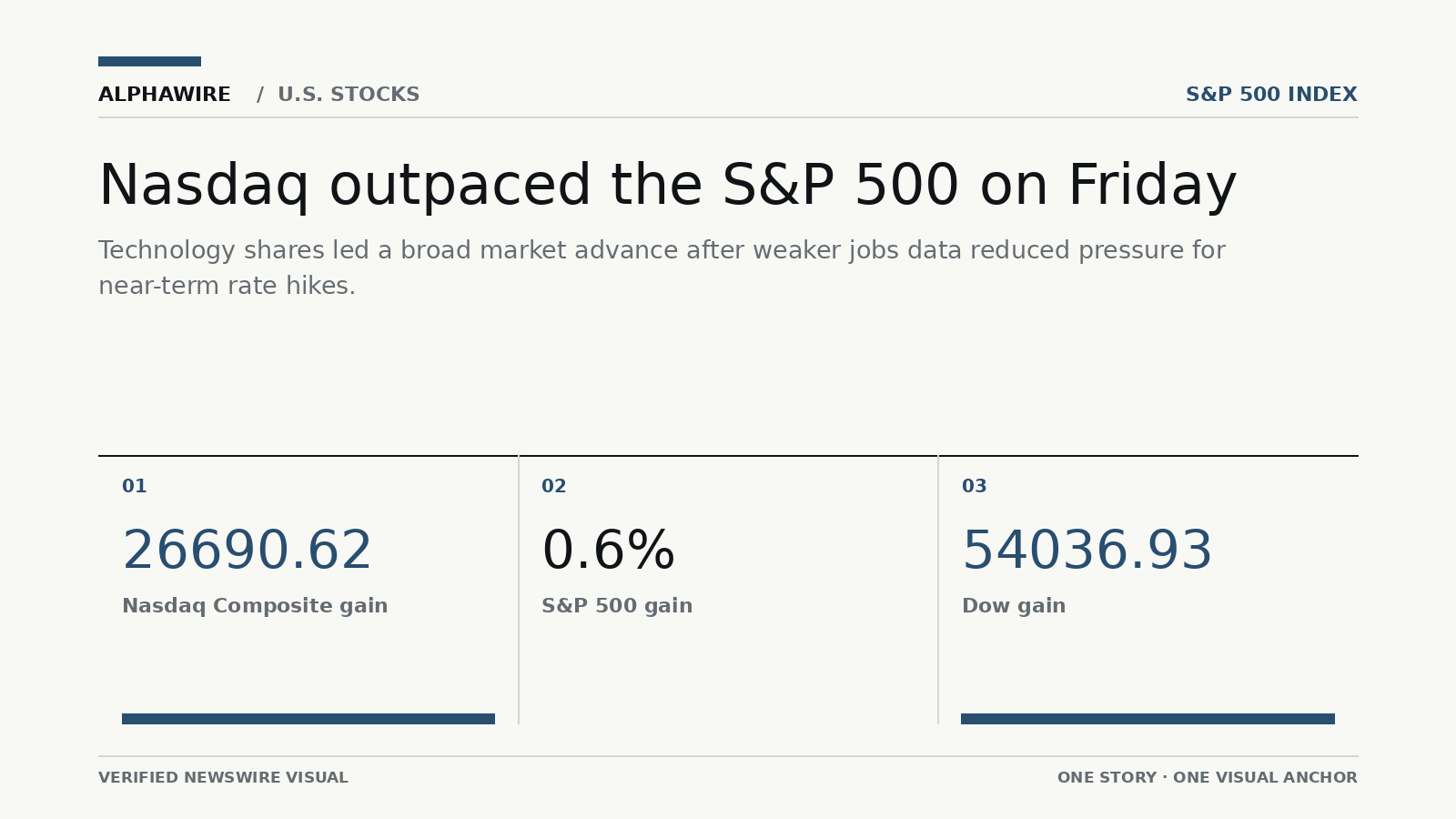
At the close, the S&P 500 rose 0.6% to 7,757.64; the Dow Jones Industrial Average gained 0.3% to 54,036.93; the Nasdaq Composite advanced 1.3% to 26,690.62; the Nasdaq 100 climbed 1.2% to 29,722.3; and the Russell 2000 increased 1.1% to 3,034.494.