As Investors Chase Nvidia, Caterpillar Points to AI’s Next Funding Destination
For the past two years, investors have largely treated artificial intelligence as a technology-sector trade. Nvidia (NVDA) has been the market’s first choice for exposure to the AI boom, while the apparent winners have mostly made chips, servers or software. Caterpillar (CAT) has just challenged that logic. The heavy-equipment giant reported a strong quarterly performance on Aug. 4, with revenue reaching a record $20.54 billion and adjusted earnings per share of $8.17, well above Wall Street’s consensus expectations. The stock jumped about 10% after the report, helping lift the Dow Jones Industrial Average by hundreds of points. The results were impressive on their own. More important, however, was the logic behind them. Chief Executive Officer Joe Creed said demand was rising across Caterpillar’s businesses, supported by a solid order book and a steadily growing backlog. Data-center construction has become a central growth theme on Wall Street and one of its most popular investment areas. “Strong orders and a growing backlog reflect a broad-based recovery in demand across our three core segments,” Creed said during the company’s quarterly earnings call. The AI supply chain does not end with Nvidia’s chips. For an AI data center to operate around the clock, companies must first prepare the land, pour foundations, install generator sets and build out the electrical system. Heavy construction equipment is required throughout that process. Tens of billions of dollars in capital are flowing toward companies that rarely appear on lists of popular AI stocks. Caterpillar’s report is an important warning for investors: the economic benefits of AI are no longer flowing only to technology developers. Industrial companies responsible for building the physical infrastructure are capturing an increasing share of the gains. AI’s Biggest Winners Are Moving Beyond Silicon Valley When investors think about AI infrastructure, chips are often the first thing that comes to mind. That view is not without merit. Large language models still rely on Nvidia graphics processors, while AMD, Broadcom and Marvell are competing to supply CPUs and networking equipment for massive computing clusters. But before processors can be installed, someone has to build the data-center facilities. Hyperscale data centers are effectively large earthmoving and construction projects. Excavation, diesel generator sets, backup power systems and heavy construction equipment are all essential. The work often takes months or even years before servers can begin handling AI workloads. That shift is already visible in Caterpillar’s results. The company said revenue surged 24% from a year earlier to a record $20.54 billion, while adjusted earnings per share climbed to $8.17. The market had expected revenue of about $18.95 billion and earnings per share of roughly $6.10. The earnings beat was not entirely attributable to AI. Mining, energy and broad-based infrastructure spending continued to support industry demand. But data-center construction is becoming an increasingly important growth engine. Microsoft, Meta and other technology giants continue to invest tens of billions of dollars to expand AI computing capacity. For Caterpillar, that means major construction projects around the world will require more excavators, loaders, engines and power-generation equipment. The report is reshaping how investors think about positioning for AI. Instead of focusing only on which company will produce the fastest chip, investors are increasingly asking who stands to benefit whenever an AI computing campus breaks ground. The potential beneficiaries include heavy-equipment manufacturers, industrial suppliers, power companies, electrical-equipment makers, cooling-system suppliers and construction firms. The AI boom is spreading through the broader industrial economy. Caterpillar Earnings Highlight an Overlooked AI Investment Opportunity Caterpillar’s results could change how investors view the AI trade. Until now, most of the money betting on the AI rally had been concentrated in semiconductor companies. That strategy has produced strong returns, helping Nvidia become one of the world’s most valuable companies. But the latest earnings season is signaling that the AI investment theme is broadening. Building AI infrastructure requires enormous capital spending, and the money is not flowing only to chips and servers. Before computing equipment can be installed, data centers need roads, foundations, generators, electrical systems, cooling facilities and a range of heavy construction machinery. Caterpillar’s quarterly revenue reached a record $20.54 billion. Adjusted earnings per share came to $8.17, substantially above Wall Street’s expectations. Management said orders were strong across the business and that the backlog continued to grow. AI data-center construction is becoming an important source of demand for heavy equipment, placing Caterpillar near the front of this investment cycle. The report shows that industrial companies can benefit from technology capital spending even if they do not develop AI software or manufacture advanced processors. Caterpillar shares are up nearly 60% this year, reflecting investors’ growing belief that AI infrastructure spending will remain an important long-term growth driver over the next several years. That does not mean Caterpillar has suddenly become a technology company. It shows that one of Wall Street’s leading investment themes is creating opportunities for a broad group of companies that previously had little apparent connection to AI. For investors looking toward the next phase of the AI trade, Caterpillar’s report offers an important lesson: the biggest AI winners are no longer confined to Silicon Valley. Some are supplying the construction equipment needed to build Silicon Valley’s future.
Caterpillar (CAT) has just challenged that logic.
The heavy-equipment giant reported a strong quarterly performance on Aug. 4, with revenue reaching a record $20.54 billion and adjusted earnings per share of $8.17, well above Wall Street’s consensus expectations. The stock jumped about 10% after the report, helping lift the Dow Jones Industrial Average by hundreds of points.
The results were impressive on their own. More important, however, was the logic behind them.
Chief Executive Officer Joe Creed said demand was rising across Caterpillar’s businesses, supported by a solid order book and a steadily growing backlog. Data-center construction has become a central growth theme on Wall Street and one of its most popular investment areas.
“Strong orders and a growing backlog reflect a broad-based recovery in demand across our three core segments,” Creed said during the company’s quarterly earnings call.
The AI supply chain does not end with Nvidia’s chips.
For an AI data center to operate around the clock, companies must first prepare the land, pour foundations, install generator sets and build out the electrical system. Heavy construction equipment is required throughout that process. Tens of billions of dollars in capital are flowing toward companies that rarely appear on lists of popular AI stocks.
Caterpillar’s report is an important warning for investors: the economic benefits of AI are no longer flowing only to technology developers. Industrial companies responsible for building the physical infrastructure are capturing an increasing share of the gains.
AI’s Biggest Winners Are Moving Beyond Silicon Valley
When investors think about AI infrastructure, chips are often the first thing that comes to mind. That view is not without merit. Large language models still rely on Nvidia graphics processors, while AMD, Broadcom and Marvell are competing to supply CPUs and networking equipment for massive computing clusters.
But before processors can be installed, someone has to build the data-center facilities.
Hyperscale data centers are effectively large earthmoving and construction projects. Excavation, diesel generator sets, backup power systems and heavy construction equipment are all essential. The work often takes months or even years before servers can begin handling AI workloads.
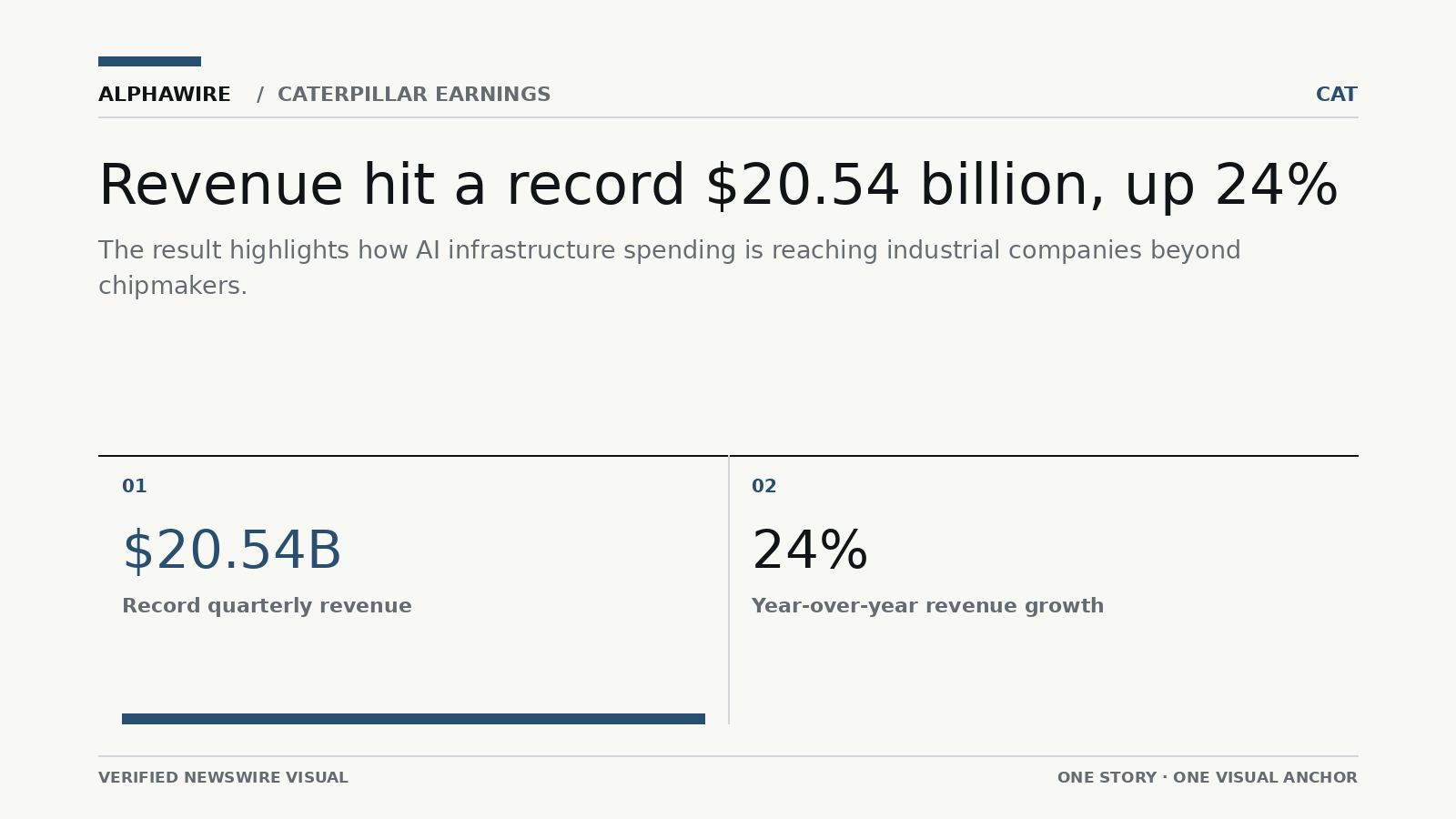
That shift is already visible in Caterpillar’s results. The company said revenue surged 24% from a year earlier to a record $20.54 billion, while adjusted earnings per share climbed to $8.17. The market had expected revenue of about $18.95 billion and earnings per share of roughly $6.10.
The earnings beat was not entirely attributable to AI. Mining, energy and broad-based infrastructure spending continued to support industry demand.
But data-center construction is becoming an increasingly important growth engine. Microsoft, Meta and other technology giants continue to invest tens of billions of dollars to expand AI computing capacity.
For Caterpillar, that means major construction projects around the world will require more excavators, loaders, engines and power-generation equipment.
The report is reshaping how investors think about positioning for AI. Instead of focusing only on which company will produce the fastest chip, investors are increasingly asking who stands to benefit whenever an AI computing campus breaks ground.
The potential beneficiaries include heavy-equipment manufacturers, industrial suppliers, power companies, electrical-equipment makers, cooling-system suppliers and construction firms. The AI boom is spreading through the broader industrial economy.
Caterpillar Earnings Highlight an Overlooked AI Investment Opportunity
Caterpillar’s results could change how investors view the AI trade. Until now, most of the money betting on the AI rally had been concentrated in semiconductor companies. That strategy has produced strong returns, helping Nvidia become one of the world’s most valuable companies.
But the latest earnings season is signaling that the AI investment theme is broadening. Building AI infrastructure requires enormous capital spending, and the money is not flowing only to chips and servers. Before computing equipment can be installed, data centers need roads, foundations, generators, electrical systems, cooling facilities and a range of heavy construction machinery.
Caterpillar’s quarterly revenue reached a record $20.54 billion. Adjusted earnings per share came to $8.17, substantially above Wall Street’s expectations. Management said orders were strong across the business and that the backlog continued to grow. AI data-center construction is becoming an important source of demand for heavy equipment, placing Caterpillar near the front of this investment cycle.
The report shows that industrial companies can benefit from technology capital spending even if they do not develop AI software or manufacture advanced processors.
Caterpillar shares are up nearly 60% this year, reflecting investors’ growing belief that AI infrastructure spending will remain an important long-term growth driver over the next several years.
That does not mean Caterpillar has suddenly become a technology company. It shows that one of Wall Street’s leading investment themes is creating opportunities for a broad group of companies that previously had little apparent connection to AI.
For investors looking toward the next phase of the AI trade, Caterpillar’s report offers an important lesson: the biggest AI winners are no longer confined to Silicon Valley. Some are supplying the construction equipment needed to build Silicon Valley’s future.