Trump Administration Backs Three Critical-Minerals Projects With $58 Million in Financing
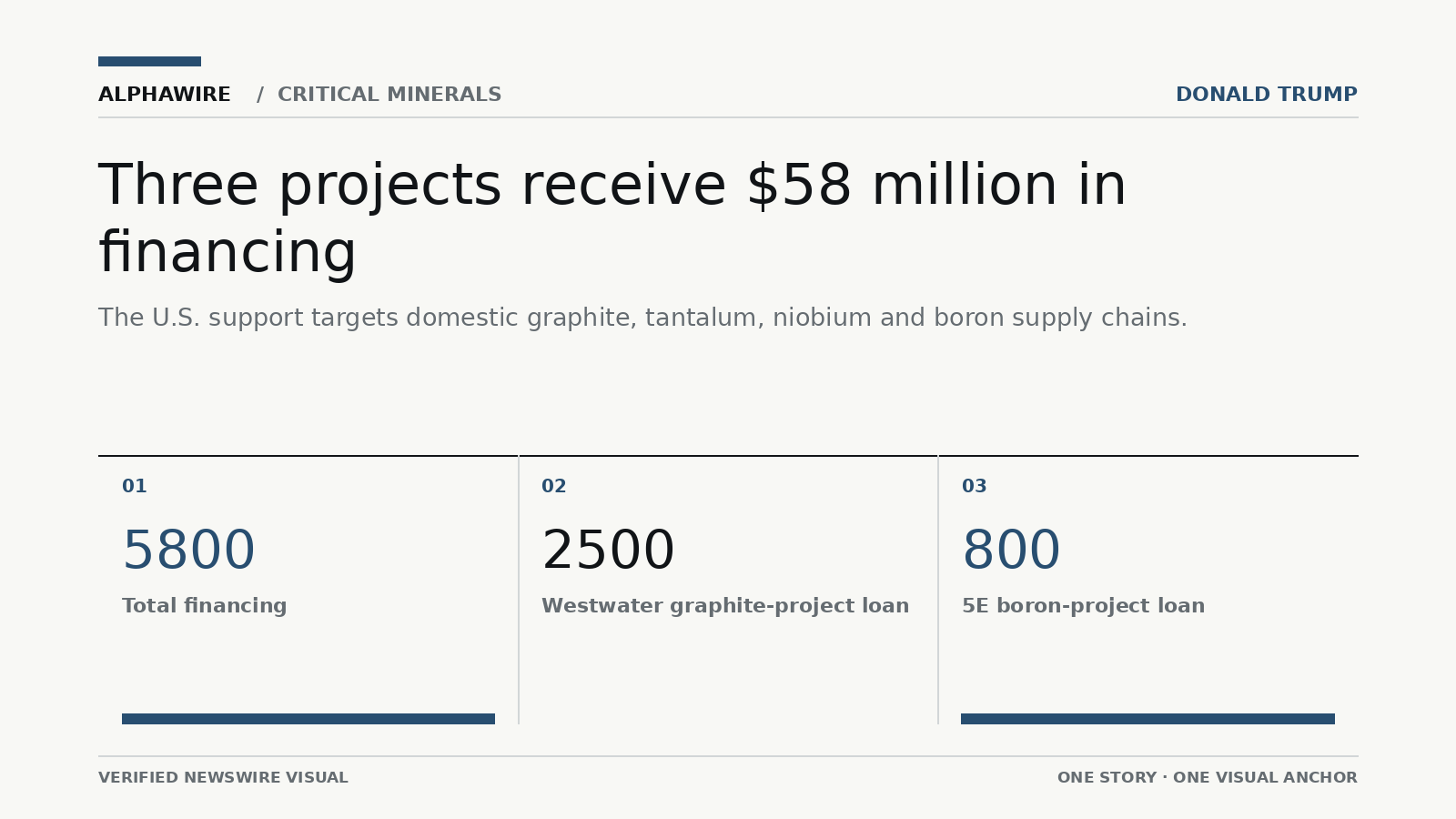
The U.S. Export-Import Bank will provide a total of $58 million in loan support to three critical-minerals companies, according to media reports. The financing is part of the Trump administration's effort to reduce reliance on foreign supplies and expand domestic mining and processing capacity. The funding was announced as Trump met Friday in Washington with some executives from the world's largest mining companies. The meeting was intended to underscore the urgent need for the United States to increase its supply of critical minerals, which are essential to weapons manufacturing and electronics production. Export-Import Bank Chairman John Jovanovic said, “Critical-minerals security is national security.” He said the financing is intended to “strengthen supply chains, restore critical industries that support high-paying American jobs, and protect ordinary Americans from supply shocks.” Westwater Resources, a U.S. graphite company, will receive a $25 million loan to support construction of its graphite mine and processing facilities in Alabama. The project could become the first U.S. source of natural graphite. During U.S. trading, Westwater's stock surged more than 100% at one point before closing 86% higher. Graphite is one of the most widely used minerals in lithium-ion batteries. The United States also produces some synthetic graphite, whose raw material is petroleum coke, a byproduct of petroleum refining. Battery manufacturers typically choose between natural and synthetic graphite based on cost, performance and other factors. Privately held Global Advanced Metals will receive a $25 million loan to expand its tantalum and niobium processing operations. The United States currently produces neither metal and has long relied on overseas supplies. The company mines the minerals in Australia and processes them in Pennsylvania. Tantalum is used mainly in capacitors for smartphones, cars and other electronic devices. Niobium is used primarily as an alloying material to increase the strength of steel and is widely used in pipelines and aircraft manufacturing. 5E Advanced Materials will receive an $8 million loan to increase boron production. The U.S. government added boron to its critical-minerals list last year. The metal is widely used in the nuclear-energy industry and in defense-related products such as body armor. The United States still imports most of the boron it needs. 5E's boron project in California is scheduled to begin commercial production in 2028. The Trump administration will also provide more than $2 billion in financing support to several other battery and critical-minerals producers, according to additional reports. White House officials said the U.S. Department of Defense has committed $1.4 billion in loans to next-generation battery company Sila Nanotechnologies and has reached financing agreements with three other companies.
The funding was announced as Trump met Friday in Washington with some executives from the world's largest mining companies. The meeting was intended to underscore the urgent need for the United States to increase its supply of critical minerals, which are essential to weapons manufacturing and electronics production.
Export-Import Bank Chairman John Jovanovic said, “Critical-minerals security is national security.” He said the financing is intended to “strengthen supply chains, restore critical industries that support high-paying American jobs, and protect ordinary Americans from supply shocks.”
Westwater Resources, a U.S. graphite company, will receive a $25 million loan to support construction of its graphite mine and processing facilities in Alabama. The project could become the first U.S. source of natural graphite.
During U.S. trading, Westwater's stock surged more than 100% at one point before closing 86% higher.
Graphite is one of the most widely used minerals in lithium-ion batteries. The United States also produces some synthetic graphite, whose raw material is petroleum coke, a byproduct of petroleum refining. Battery manufacturers typically choose between natural and synthetic graphite based on cost, performance and other factors.
Privately held Global Advanced Metals will receive a $25 million loan to expand its tantalum and niobium processing operations.
The United States currently produces neither metal and has long relied on overseas supplies. The company mines the minerals in Australia and processes them in Pennsylvania.
Tantalum is used mainly in capacitors for smartphones, cars and other electronic devices. Niobium is used primarily as an alloying material to increase the strength of steel and is widely used in pipelines and aircraft manufacturing.
5E Advanced Materials will receive an $8 million loan to increase boron production.
The U.S. government added boron to its critical-minerals list last year. The metal is widely used in the nuclear-energy industry and in defense-related products such as body armor.
The United States still imports most of the boron it needs. 5E's boron project in California is scheduled to begin commercial production in 2028.
The Trump administration will also provide more than $2 billion in financing support to several other battery and critical-minerals producers, according to additional reports.
White House officials said the U.S. Department of Defense has committed $1.4 billion in loans to next-generation battery company Sila Nanotechnologies and has reached financing agreements with three other companies.