Space X, Tesla Announce $16.8 Billion Initial Investment in Terafab Chip Plant
Elon Musk's Terafab superchip factory project has moved from the planning stage to a concrete investment commitment. SpaceX said on its website Thursday that construction of the Terafab plant will begin in Grimes County, Texas. The initial investment from SpaceX and Tesla is $16.8 billion, while future expansion could increase the total investment substantially. Musk also posted futuristic concept images of Terafab on social media and said the facility would become "the largest and most valuable building on Earth." The announcement did not specify an initial production target. It reiterated that Terafab ultimately aims to produce "1 terawatt of computing power per year." One terawatt equals 1,000 gigawatts. In a filing this May, SpaceX said the project's final investment could reach as much as $119 billion. SpaceX said the facility is planned to include more than 100 million square feet of manufacturing space, equivalent to 9.3 million square meters. Advanced logic chips and memory chips will be manufactured, packaged and tested at the same site. The plant will produce processors for Tesla's Optimus humanoid robots and Cybercab autonomous taxis, as well as high-power chips for SpaceX's space-based data centers. Musk said on social media Thursday that, based on a rough estimate, about 25% of Terafab's AI computing capacity would be used for Tesla's Optimus robots and 75% for AI spacecraft. Terafab's explicit focus on memory chips would put it in competition with Samsung Electronics, SK Hynix and Micron Technology. Intel had previously said it would participate in the Terafab project, but its strengths are in logic chips and advanced packaging, limiting the assistance it could provide in memory. Tesla's website shows that the company is recruiting a memory process integration engineer to lead end-to-end process integration for DRAM memory-cell structures, from capacitor design through execution of the full process flow, and to ensure high-volume manufacturing readiness. Based on construction timelines at TSMC and Intel, a wafer fab can take three to five years from groundbreaking to yield ramp-up. As a result, Musk's ambitious chip plant may struggle to change the chip-supply landscape in the near term. It is also not yet clear what process nodes the facility will use or how it will secure critical equipment such as ASML lithography machines.
SpaceX said on its website Thursday that construction of the Terafab plant will begin in Grimes County, Texas. The initial investment from SpaceX and Tesla is $16.8 billion, while future expansion could increase the total investment substantially.
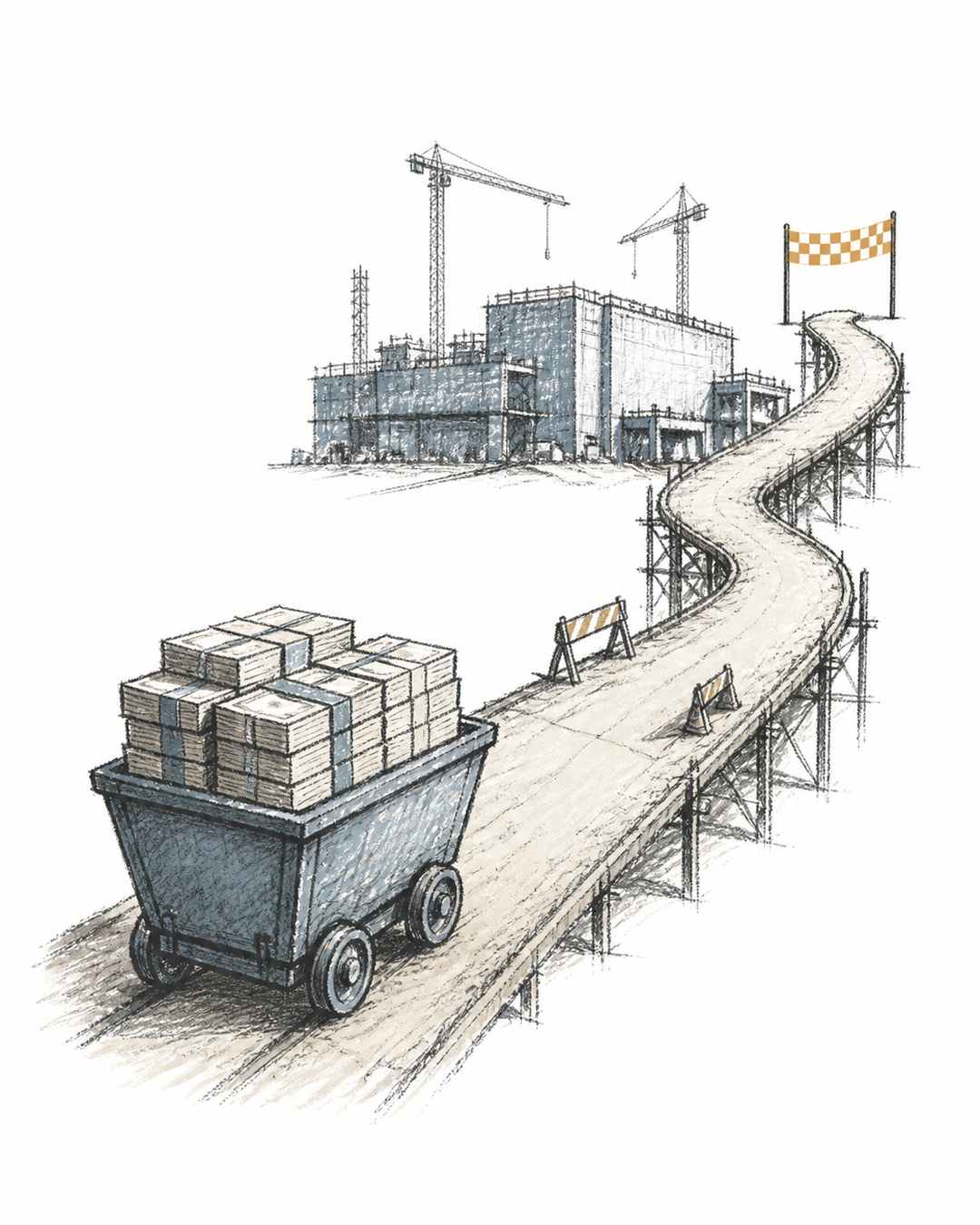
Musk also posted futuristic concept images of Terafab on social media and said the facility would become "the largest and most valuable building on Earth."
The announcement did not specify an initial production target. It reiterated that Terafab ultimately aims to produce "1 terawatt of computing power per year." One terawatt equals 1,000 gigawatts.
In a filing this May, SpaceX said the project's final investment could reach as much as $119 billion.
SpaceX said the facility is planned to include more than 100 million square feet of manufacturing space, equivalent to 9.3 million square meters. Advanced logic chips and memory chips will be manufactured, packaged and tested at the same site.
The plant will produce processors for Tesla's Optimus humanoid robots and Cybercab autonomous taxis, as well as high-power chips for SpaceX's space-based data centers.
Musk said on social media Thursday that, based on a rough estimate, about 25% of Terafab's AI computing capacity would be used for Tesla's Optimus robots and 75% for AI spacecraft.
Terafab's explicit focus on memory chips would put it in competition with Samsung Electronics, SK Hynix and Micron Technology. Intel had previously said it would participate in the Terafab project, but its strengths are in logic chips and advanced packaging, limiting the assistance it could provide in memory.
Tesla's website shows that the company is recruiting a memory process integration engineer to lead end-to-end process integration for DRAM memory-cell structures, from capacitor design through execution of the full process flow, and to ensure high-volume manufacturing readiness.
Based on construction timelines at TSMC and Intel, a wafer fab can take three to five years from groundbreaking to yield ramp-up. As a result, Musk's ambitious chip plant may struggle to change the chip-supply landscape in the near term. It is also not yet clear what process nodes the facility will use or how it will secure critical equipment such as ASML lithography machines.