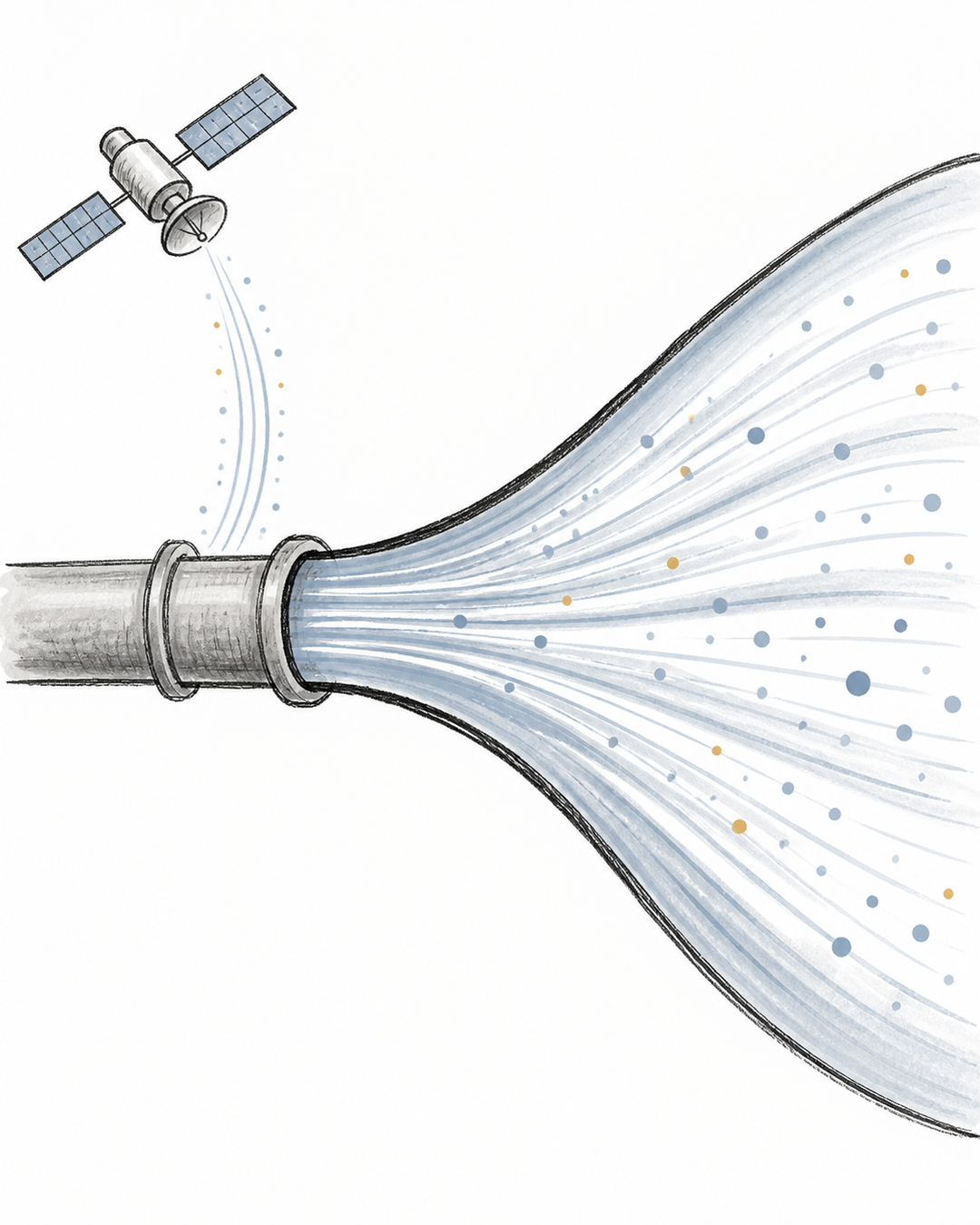
Musk Says V 3 Starlink Satellites Could Deliver More Than 100 x Gen 2 Bandwidth
Elon Musk said on Aug. 8, local time, in a post on X that SpaceX’s third-generation Starlink satellites, or V3, launched by Starship will have overall performance an order of magnitude higher than the second-generation V2 satellites currently launched by Falcon rockets, according to Cailian Press. Musk said SpaceX will later launch V3 and newer versions of Starlink satellites in quantities another order of magnitude larger, while also carrying V2 and updated versions of direct-to-cell satellites. He said this would bring total bandwidth to more than 100 times that of the second-generation Starlink system. Musk also said the second-generation Starlink system’s annual recurring revenue will reach $20 billion this year and that SpaceX’s communications business will generate more than $200 billion in annual revenue. Morgan Stanley forecasts that the global space industry will grow from $350 billion in 2016 to more than $1.1 trillion by 2040, with half of the increase coming from next-generation internet satellites. Inter-satellite laser links have become standard equipment for large constellations, driving demand for inter-satellite laser communications terminals. China has become the world’s second country to master large-capacity reusable rocket technology, while offshore network-based rocket recovery is described as a world-first technical approach. Advances in rocket capacity and cost—two critical bottlenecks—are making large-scale, low-cost satellite deployment feasible. Guohai Securities said the expansion of computing capacity into space is enlarging the addressable market for the satellite industry while helping establish a complete commercial model. The sharp increase in demand for large constellations, combined with breakthroughs in reusable rocket technology, is making large-scale, low-cost satellite deployment feasible. Comparing the cost differences between space-based and terrestrial computing can help break down satellite internet’s business model and monetization path, the brokerage said. China Galaxy Securities said the world’s first network-based recovery of a launch vehicle’s booster stage marks a breakthrough in China’s reusable rocket technology and opens additional room for commercial growth. Unlike SpaceX’s Falcon 9, which uses landing legs for vertical recovery, the Long March 10B’s first stage eliminated the heavy landing legs and was successfully recovered through a net-capture method. The brokerage said this provides firm support for China’s subsequent high-density, heavy-payload and batch constellation launches. Related research: - Wanlian Securities, “Communications Industry: Domestic and Overseas Computing Investment Form a Resonance, Accelerating the Large-Scale Deployment of Satellite Internet,” Aug. 4, 2026. - Guohai Securities, “Defense and Military Industry: China’s Rocket Achieves Controlled Recovery of a Booster Stage for the First Time, and the Satellite Internet Era May Accelerate,” July 14, 2026. - China Galaxy Securities, “Communications Industry: Breaking Through With Network-Based Recovery, Satellite Internet May Accelerate,” July 10, 2026.
Musk said SpaceX will later launch V3 and newer versions of Starlink satellites in quantities another order of magnitude larger, while also carrying V2 and updated versions of direct-to-cell satellites. He said this would bring total bandwidth to more than 100 times that of the second-generation Starlink system.
Musk also said the second-generation Starlink system’s annual recurring revenue will reach $20 billion this year and that SpaceX’s communications business will generate more than $200 billion in annual revenue.
Morgan Stanley forecasts that the global space industry will grow from $350 billion in 2016 to more than $1.1 trillion by 2040, with half of the increase coming from next-generation internet satellites. Inter-satellite laser links have become standard equipment for large constellations, driving demand for inter-satellite laser communications terminals.
China has become the world’s second country to master large-capacity reusable rocket technology, while offshore network-based rocket recovery is described as a world-first technical approach. Advances in rocket capacity and cost—two critical bottlenecks—are making large-scale, low-cost satellite deployment feasible.
Guohai Securities said the expansion of computing capacity into space is enlarging the addressable market for the satellite industry while helping establish a complete commercial model. The sharp increase in demand for large constellations, combined with breakthroughs in reusable rocket technology, is making large-scale, low-cost satellite deployment feasible. Comparing the cost differences between space-based and terrestrial computing can help break down satellite internet’s business model and monetization path, the brokerage said.
China Galaxy Securities said the world’s first network-based recovery of a launch vehicle’s booster stage marks a breakthrough in China’s reusable rocket technology and opens additional room for commercial growth. Unlike SpaceX’s Falcon 9, which uses landing legs for vertical recovery, the Long March 10B’s first stage eliminated the heavy landing legs and was successfully recovered through a net-capture method. The brokerage said this provides firm support for China’s subsequent high-density, heavy-payload and batch constellation launches.
Related research:
- Wanlian Securities, “Communications Industry: Domestic and Overseas Computing Investment Form a Resonance, Accelerating the Large-Scale Deployment of Satellite Internet,” Aug. 4, 2026.
- Guohai Securities, “Defense and Military Industry: China’s Rocket Achieves Controlled Recovery of a Booster Stage for the First Time, and the Satellite Internet Era May Accelerate,” July 14, 2026.
- China Galaxy Securities, “Communications Industry: Breaking Through With Network-Based Recovery, Satellite Internet May Accelerate,” July 10, 2026.