S&P 500 Nears Record High. Is It Safe to Buy Stocks Now?
The S&P 500 has risen 13% so far in 2026 and is on track to post a double-digit gain for a fourth consecutive year. Large-scale artificial-intelligence investment has driven strong corporate earnings growth, supporting the stock market. Wall Street institutions expect the favorable earnings trend to continue over the next several quarters. But the S&P 500 reached a record high of 7,758 points on Aug. 7. With the index close to its peak, is it safe to buy stocks now? Investors may want to consider Warren Buffett's views while also examining the index's historical performance after reaching new highs. Buffett's approach to stock selection in any market environment Buffett has never avoided buying stocks simply because the S&P 500 was near a record high. Throughout his investing career, he has relied on a value-investing framework while continuing to deploy capital into Berkshire Hathaway. In Berkshire's 1996 letter to shareholders, he summarized the approach in straightforward terms: “As an investor, your goal is simple: to buy, at a rational price, a part interest in an easily understandable business whose earnings are virtually certain to be materially higher five, 10 and 20 years from now.” Buffett's explanation did not mention a broad-market index. That is because whether the S&P 500 is at a record high is, in itself, not the decisive issue. What matters is the valuation of the individual stock or index: Is the current valuation high or low relative to expected earnings growth, and how does it compare with historical averages? The S&P 500 currently trades at 28 times earnings, clearly above its five-year average of 24 times. But FactSet data shows that earnings for S&P 500 companies are expected to grow at an annualized rate of as much as 22% through 2027. From that perspective, the index's current valuation can be viewed as reasonable, and long-term investors can consider broad-based S&P 500 index funds. Historical pattern: New highs have often been followed by solid returns Conventional wisdom, or simple intuition, says that an index at a record high is a poor time to buy. Many people treat an all-time high as a ceiling. But the S&P 500 has historically reached a new high about once every 15 trading days. Historical data also shows that investing when the index is at a new high has generally produced substantial returns. According to the table referenced in the source, entering at a new high produced average medium- and long-term returns that were generally better than investing on a randomly selected trading day. The source includes a “Data source” line, but does not identify the underlying source. The table compares average returns after entering at a new S&P 500 high with average returns after entering on any trading day. From 1988 through 2024, the S&P 500 produced an average one-year return of 13% after reaching a new high, slightly above the 12% average annual return after a purchase on a random trading day. The average return after entering at a new high was also higher over the two-, three- and five-year periods. In short, history suggests that a new high should not, by itself, be a reason to avoid stocks. Combined with Buffett's principle of buying an individual stock or index fund only at a reasonable valuation, the takeaway is that investors can consider investing when an attractive opportunity is available. Past performance does not guarantee future returns. Potential interest-rate hikes and the U.S. midterm elections could weigh on stocks in the coming months. In addition, if S&P 500 companies' earnings fall short of Wall Street's optimistic expectations in the next several quarters, investors could lower their forecasts, potentially triggering a sharp market correction.
But the S&P 500 reached a record high of 7,758 points on Aug. 7. With the index close to its peak, is it safe to buy stocks now? Investors may want to consider Warren Buffett's views while also examining the index's historical performance after reaching new highs.
Buffett's approach to stock selection in any market environment
Buffett has never avoided buying stocks simply because the S&P 500 was near a record high. Throughout his investing career, he has relied on a value-investing framework while continuing to deploy capital into Berkshire Hathaway. In Berkshire's 1996 letter to shareholders, he summarized the approach in straightforward terms:
“As an investor, your goal is simple: to buy, at a rational price, a part interest in an easily understandable business whose earnings are virtually certain to be materially higher five, 10 and 20 years from now.”
Buffett's explanation did not mention a broad-market index. That is because whether the S&P 500 is at a record high is, in itself, not the decisive issue. What matters is the valuation of the individual stock or index: Is the current valuation high or low relative to expected earnings growth, and how does it compare with historical averages?
The S&P 500 currently trades at 28 times earnings, clearly above its five-year average of 24 times. But FactSet data shows that earnings for S&P 500 companies are expected to grow at an annualized rate of as much as 22% through 2027. From that perspective, the index's current valuation can be viewed as reasonable, and long-term investors can consider broad-based S&P 500 index funds.
Historical pattern: New highs have often been followed by solid returns
Conventional wisdom, or simple intuition, says that an index at a record high is a poor time to buy. Many people treat an all-time high as a ceiling. But the S&P 500 has historically reached a new high about once every 15 trading days.
Historical data also shows that investing when the index is at a new high has generally produced substantial returns. According to the table referenced in the source, entering at a new high produced average medium- and long-term returns that were generally better than investing on a randomly selected trading day. The source includes a “Data source” line, but does not identify the underlying source.
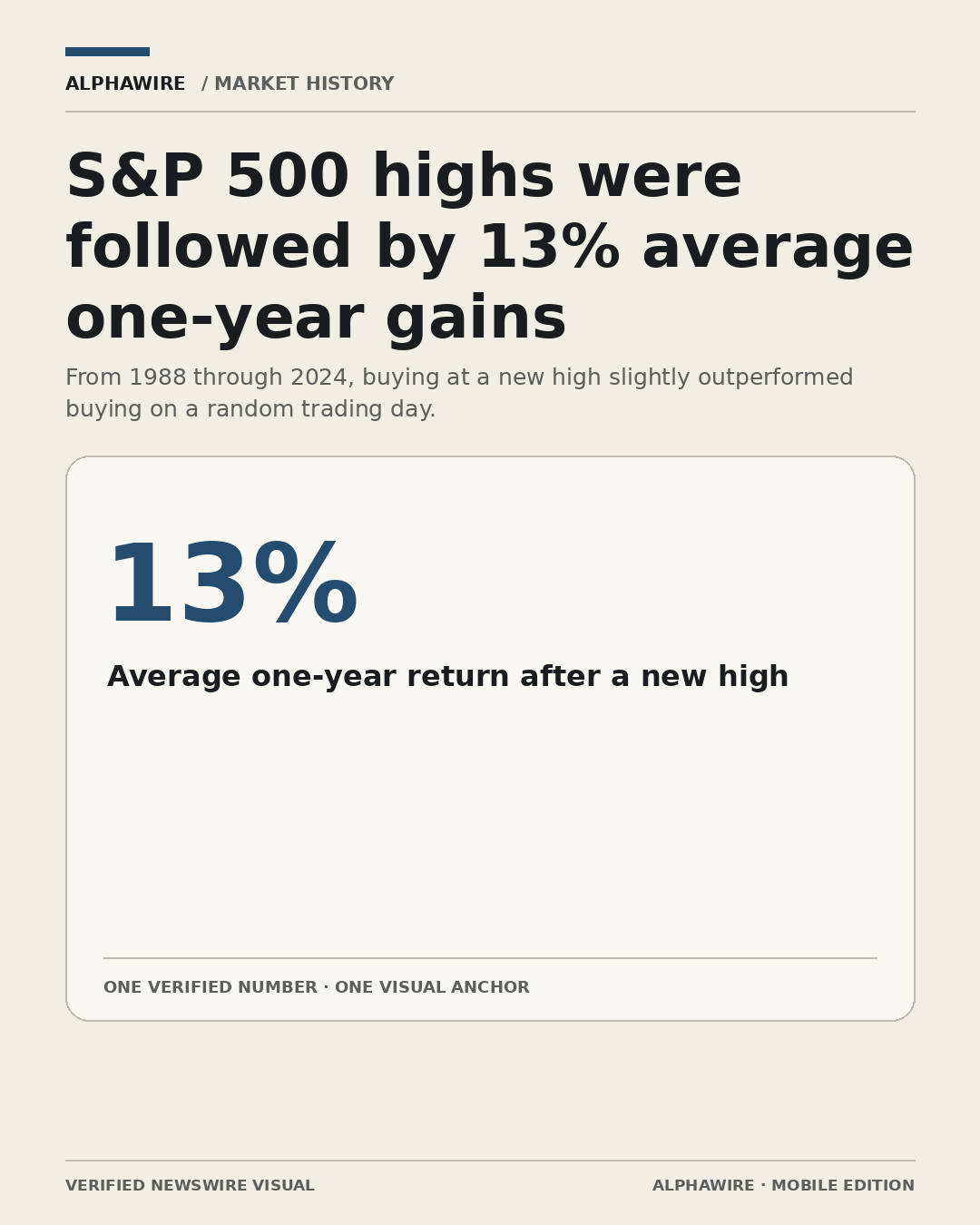
The table compares average returns after entering at a new S&P 500 high with average returns after entering on any trading day. From 1988 through 2024, the S&P 500 produced an average one-year return of 13% after reaching a new high, slightly above the 12% average annual return after a purchase on a random trading day. The average return after entering at a new high was also higher over the two-, three- and five-year periods.
In short, history suggests that a new high should not, by itself, be a reason to avoid stocks. Combined with Buffett's principle of buying an individual stock or index fund only at a reasonable valuation, the takeaway is that investors can consider investing when an attractive opportunity is available.
Past performance does not guarantee future returns. Potential interest-rate hikes and the U.S. midterm elections could weigh on stocks in the coming months. In addition, if S&P 500 companies' earnings fall short of Wall Street's optimistic expectations in the next several quarters, investors could lower their forecasts, potentially triggering a sharp market correction.