U.S. Core Inflation Remained Moderate in July, Dimming Fed Rate-Hike Bets
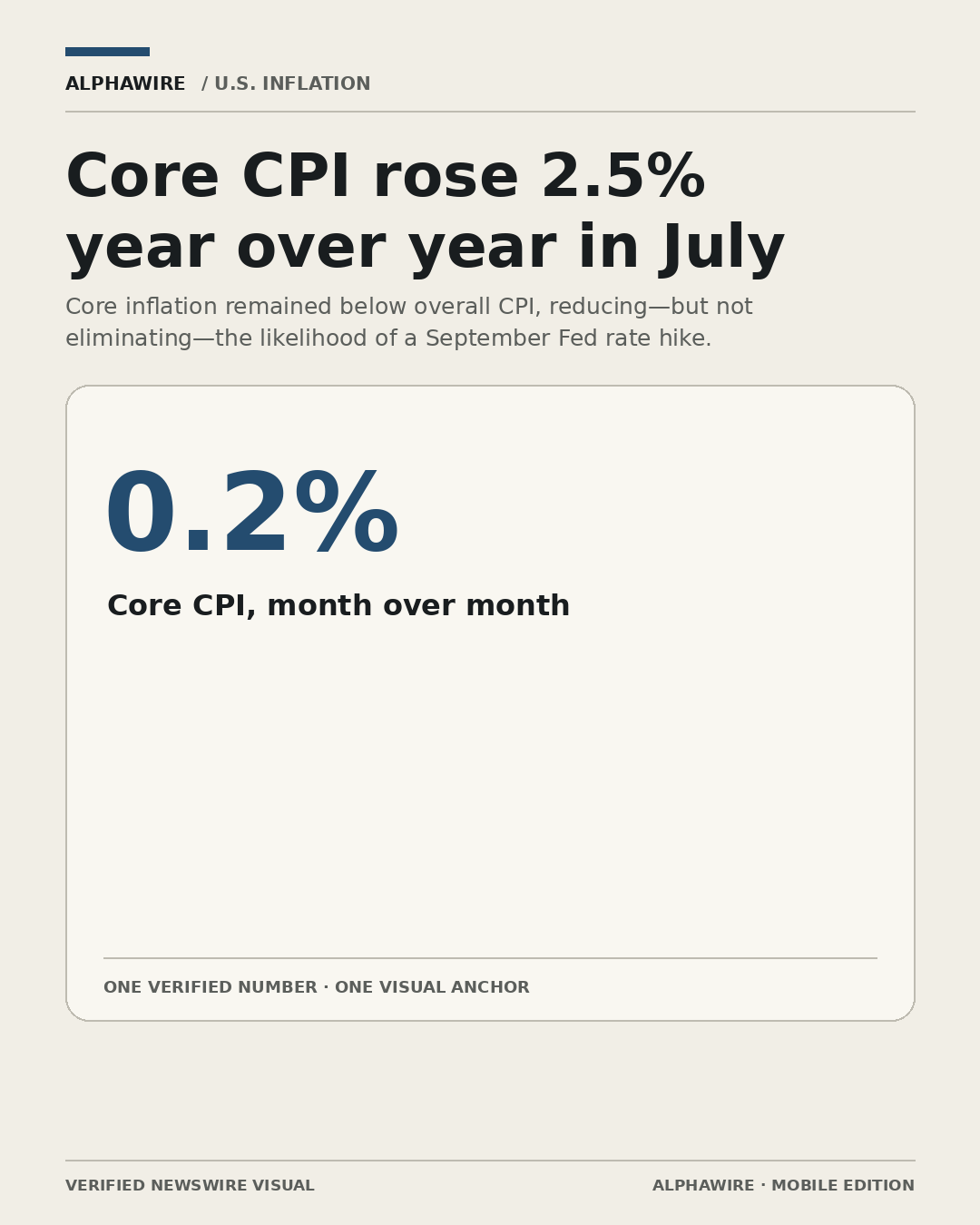
The core consumer price index, which excludes volatile food and energy categories, rose 0.2% in July from the previous month, according to data released Wednesday by the U.S. Bureau of Labor Statistics. Core CPI rose 2.5% from a year earlier, matching its lowest annual growth rate since March 2021. Overall, the consumer price index rose 0.1% month over month and 3.4% year over year in July. The report showed that the impact of the energy-price shock triggered by the Iran war continued to fade in July. The data could give the Federal Reserve more room to weigh inflation pressures against a recent slowdown in hiring as it considers whether to raise interest rates at its Sept. 15-16 meeting. Before the September meeting, policymakers will receive additional employment and inflation reports. Investors will also closely watch remarks expected later this month from Fed Chair Kevin Warsh at the central bank's annual Jackson Hole symposium. Oscar Munoz, head of U.S. economic research at TD Securities, said: “This is good news for Fed officials who want to remain patient. At least for those who want to see further progress on inflation and continued signs of cooling, this is the second consecutive report like this.” U.S. stocks opened higher and Treasury yields fell. Investors reduced their bets on a Fed rate hike in September. Energy and gasoline prices fell for a second consecutive month. After a U.S.-Iran cease-fire agreement broke down and hostilities resumed, U.S. gasoline prices rose above $4 a gallon again in July. On a monthly average, however, they remained below June's level. Grocery prices fell for the first time since March, partly because lettuce prices posted a record decline during the cyclospora outbreak. The price of uncooked ground beef fell 1.6%, the biggest drop since 2020. Shelter costs rose 0.1%, restrained by a 3.3% decline in hotel and motel prices. Prices for services excluding energy and rent rose a moderate 0.2% after declining in the previous month. Prices increased in service categories including health care and airfares. Computer-category goods inflation U.S. goods prices excluding food and energy rebounded after falling for two consecutive months. Prices for computer software and accessories rose 21.2% from a year earlier, a record increase. Prices for computers, peripherals and smart-home assistants posted their largest increase in more than four years. Economists are watching the impact of price increases announced in June for popular consumer technology products, including Apple's Mac and iPad. Memory-chip shortages, driven by the global race to build data centers, have pushed up prices for those products. “July's CPI report was mild enough to reduce the likelihood of a September rate hike, but not enough to rule it out entirely. With core CPI matching the five-year low set in February, combined with a decline in July employment, it is difficult to find a reason for an urgent rate increase,” Economic Research said. The comments were attributed to Anna Wong and Troy Durie. Producer-price data due Thursday could provide clues about additional categories that feed more directly into the inflation measure favored by the Fed. That measure is based on the personal-consumption expenditures price index, for which the relevant data will be released later this month. So far this year, core inflation measured by PCE has generally been higher than inflation measured by CPI. The U.S. Bureau of Economic Analysis will revise the way prices for some components of the PCE index are calculated in September, including legal services, computer software and investment advice. A separate report released Wednesday that combined inflation data with recent wage data showed that real average hourly earnings fell 0.2% from a year earlier in July, extending a series of weak readings since the Iran war began.
Overall, the consumer price index rose 0.1% month over month and 3.4% year over year in July.
The report showed that the impact of the energy-price shock triggered by the Iran war continued to fade in July. The data could give the Federal Reserve more room to weigh inflation pressures against a recent slowdown in hiring as it considers whether to raise interest rates at its Sept. 15-16 meeting.
Before the September meeting, policymakers will receive additional employment and inflation reports. Investors will also closely watch remarks expected later this month from Fed Chair Kevin Warsh at the central bank's annual Jackson Hole symposium.
Oscar Munoz, head of U.S. economic research at TD Securities, said: “This is good news for Fed officials who want to remain patient. At least for those who want to see further progress on inflation and continued signs of cooling, this is the second consecutive report like this.”
U.S. stocks opened higher and Treasury yields fell. Investors reduced their bets on a Fed rate hike in September.
Energy and gasoline prices fell for a second consecutive month. After a U.S.-Iran cease-fire agreement broke down and hostilities resumed, U.S. gasoline prices rose above $4 a gallon again in July. On a monthly average, however, they remained below June's level.
Grocery prices fell for the first time since March, partly because lettuce prices posted a record decline during the cyclospora outbreak. The price of uncooked ground beef fell 1.6%, the biggest drop since 2020.
Shelter costs rose 0.1%, restrained by a 3.3% decline in hotel and motel prices.
Prices for services excluding energy and rent rose a moderate 0.2% after declining in the previous month. Prices increased in service categories including health care and airfares.
Computer-category goods inflation
U.S. goods prices excluding food and energy rebounded after falling for two consecutive months. Prices for computer software and accessories rose 21.2% from a year earlier, a record increase. Prices for computers, peripherals and smart-home assistants posted their largest increase in more than four years.
Economists are watching the impact of price increases announced in June for popular consumer technology products, including Apple's Mac and iPad. Memory-chip shortages, driven by the global race to build data centers, have pushed up prices for those products.
“July's CPI report was mild enough to reduce the likelihood of a September rate hike, but not enough to rule it out entirely. With core CPI matching the five-year low set in February, combined with a decline in July employment, it is difficult to find a reason for an urgent rate increase,” Economic Research said. The comments were attributed to Anna Wong and Troy Durie.
Producer-price data due Thursday could provide clues about additional categories that feed more directly into the inflation measure favored by the Fed. That measure is based on the personal-consumption expenditures price index, for which the relevant data will be released later this month. So far this year, core inflation measured by PCE has generally been higher than inflation measured by CPI.
The U.S. Bureau of Economic Analysis will revise the way prices for some components of the PCE index are calculated in September, including legal services, computer software and investment advice.
A separate report released Wednesday that combined inflation data with recent wage data showed that real average hourly earnings fell 0.2% from a year earlier in July, extending a series of weak readings since the Iran war began.