South Korean Stocks Jump 23% in 10 Days as Chip Shares Resume Rally
South Korean stocks rallied, with the benchmark index poised to enter a technical bull market as a rebound in the global artificial-intelligence trade rapidly reverses last month’s historic rout. The benchmark Kospi index rose as much as 4.8% on Thursday, taking its cumulative gain to about 23% from its July 30 low. Heavyweights Samsung Electronics and SK Hynix contributed the most to the advance, with both stocks rising more than 5%. Enthusiasm for technology hardware stocks is returning as global technology giants show in their latest earnings reports that large-scale AI spending is continuing. That sentiment is a sharp contrast with the past several months, when forced unwinding of leveraged chip-stock positions not only triggered trading suspensions but also cost retail investors billions of dollars. Recent government restrictions on single-stock leveraged ETFs, along with signs that investors are reducing margin debt, have helped stabilize the market. “I think the market became oversold during the unwinding of leveraged positions, and the current rebound is a natural development as fund flows stabilize,” said Kang DaeKwun, chief executive officer of Life Asset Management. “However, in my view, it will be difficult for the market to sustain a prolonged rally until the AI-related narrative and the U.S. interest-rate outlook stabilize.” A mild U.S. inflation report released Wednesday provided another boost to the market by easing concerns about an imminent Federal Reserve rate hike and lifting the shares of U.S.-listed chip peers. Expectations that Samsung Electronics and SK Hynix will soon announce shareholder-return plans also improved market sentiment in recent trading sessions. The Kospi has gained more than 60% so far this year, driven by retail-investor funds, but remains about 24% below its late-June high. The index plunged 22% in July, its worst monthly performance since the global financial crisis. Last month’s turmoil produced a record number of trading suspensions, while intraday swings of more than 5% in the Kospi became common. The market has begun to regain its composure as the volatility gauge fell to its lowest level since April. Market turbulence has gradually subsided as regulators step up measures to curb retail investors’ frenzied demand for single-stock leveraged ETFs linked to chipmakers. Trading volumes for those products have fallen sharply under new minimum cash-margin requirements. Foreign investors remain net sellers as the market has become crowded and overheated, withdrawing more than $100 billion from South Korean stocks this year. Some overseas funds, however, have begun to return as the selloff pushed valuations to more attractive levels. “Memory demand has exploded because of applications involving AI agents and physical AI, but when we entered this area, supply capacity was extremely limited—that is the bottleneck,” said Qian Zhang, an emerging-markets equity investment specialist at Baillie Gifford. “We are not saying the whole world will build data centers at this pace forever, but this is a real physical bottleneck, and only a small number of companies globally can solve it.”
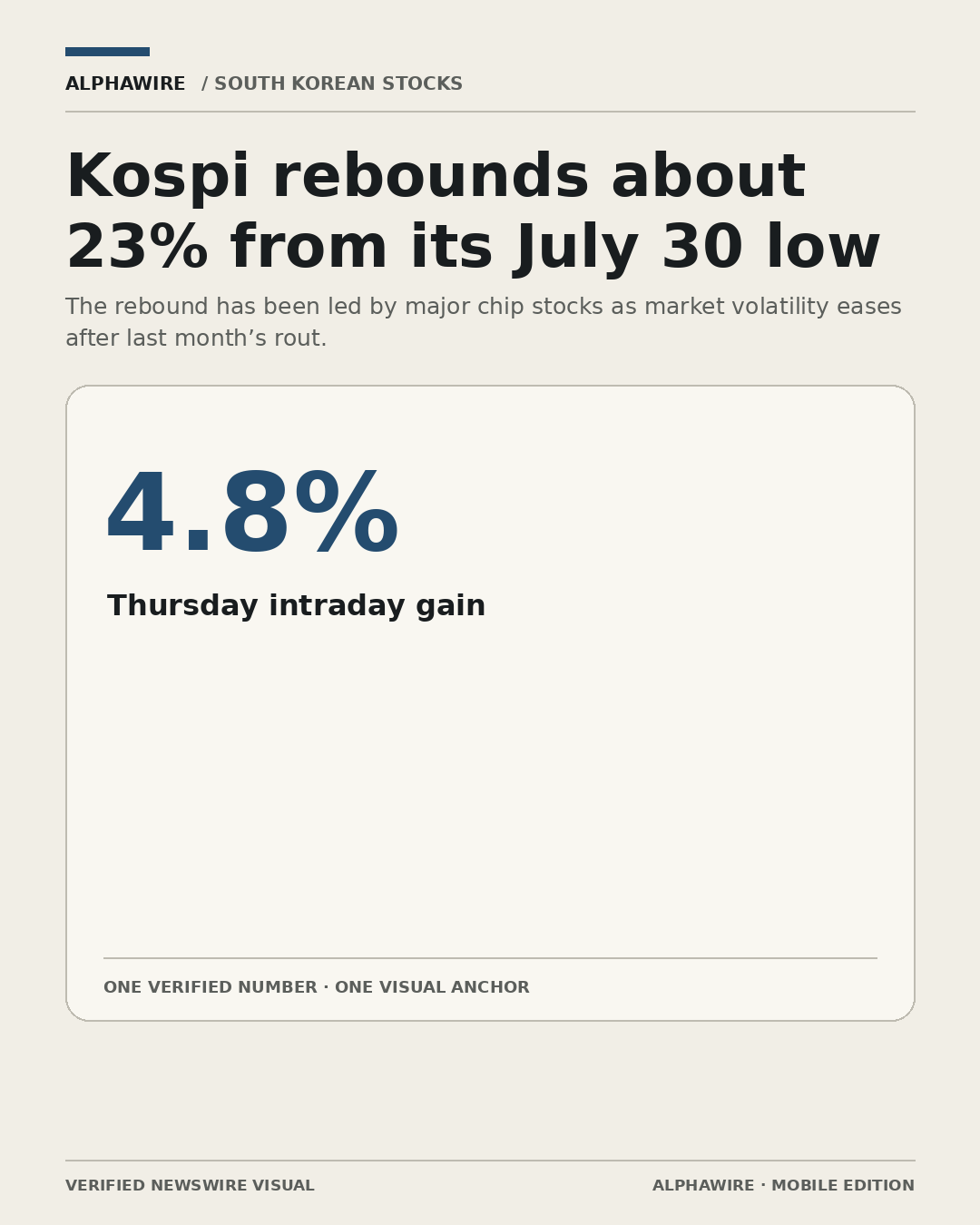
The benchmark Kospi index rose as much as 4.8% on Thursday, taking its cumulative gain to about 23% from its July 30 low. Heavyweights Samsung Electronics and SK Hynix contributed the most to the advance, with both stocks rising more than 5%.
Enthusiasm for technology hardware stocks is returning as global technology giants show in their latest earnings reports that large-scale AI spending is continuing. That sentiment is a sharp contrast with the past several months, when forced unwinding of leveraged chip-stock positions not only triggered trading suspensions but also cost retail investors billions of dollars. Recent government restrictions on single-stock leveraged ETFs, along with signs that investors are reducing margin debt, have helped stabilize the market.
“I think the market became oversold during the unwinding of leveraged positions, and the current rebound is a natural development as fund flows stabilize,” said Kang DaeKwun, chief executive officer of Life Asset Management. “However, in my view, it will be difficult for the market to sustain a prolonged rally until the AI-related narrative and the U.S. interest-rate outlook stabilize.”
A mild U.S. inflation report released Wednesday provided another boost to the market by easing concerns about an imminent Federal Reserve rate hike and lifting the shares of U.S.-listed chip peers. Expectations that Samsung Electronics and SK Hynix will soon announce shareholder-return plans also improved market sentiment in recent trading sessions.
The Kospi has gained more than 60% so far this year, driven by retail-investor funds, but remains about 24% below its late-June high. The index plunged 22% in July, its worst monthly performance since the global financial crisis.
Last month’s turmoil produced a record number of trading suspensions, while intraday swings of more than 5% in the Kospi became common. The market has begun to regain its composure as the volatility gauge fell to its lowest level since April.
Market turbulence has gradually subsided as regulators step up measures to curb retail investors’ frenzied demand for single-stock leveraged ETFs linked to chipmakers. Trading volumes for those products have fallen sharply under new minimum cash-margin requirements.
Foreign investors remain net sellers as the market has become crowded and overheated, withdrawing more than $100 billion from South Korean stocks this year. Some overseas funds, however, have begun to return as the selloff pushed valuations to more attractive levels.
“Memory demand has exploded because of applications involving AI agents and physical AI, but when we entered this area, supply capacity was extremely limited—that is the bottleneck,” said Qian Zhang, an emerging-markets equity investment specialist at Baillie Gifford. “We are not saying the whole world will build data centers at this pace forever, but this is a real physical bottleneck, and only a small number of companies globally can solve it.”