Sandisk shares jump 14% as company sees AI inference driving storage demand
U.S. flash-memory maker Sandisk issued a long-term outlook that far exceeded market expectations. At its investor day on Aug. 13, Sandisk unveiled a growth strategy and long-term financial model extending through fiscal 2030. The company expects revenue to grow at a mid- to high-teens rate from fiscal 2028 through fiscal 2030. It also expects an adjusted gross margin of about 80%, an adjusted operating margin of about 75% and a free-cash-flow margin of about 50%. Sandisk said that after completing its business investments, it plans to return 100% of its remaining cash to shareholders. The long-term profitability model, which analysts described as moving beyond the traditional NAND flash-memory cycle, was quickly embraced by investors. Sandisk shares rose 13.67% at Thursday's close, making the stock one of the S&P 500's best performers that day. The move came after Sandisk's stock briefly fell following the company’s release of record quarterly results on Aug. 5. The decline was mainly attributed to Sandisk's revenue guidance of $10.3 billion to $10.8 billion for the following quarter, below the market's estimate of about $10.82 billion. At the time, investors questioned whether Sandisk could sustain its growth amid elevated expectations. The investor day appeared to be Sandisk's positive response to the market's earlier concern that its results had already peaked. Analysts said Sandisk used the investor day to argue that AI is changing the structure of demand in the NAND industry and that the company is using technology upgrades, product-mix adjustments and long-term contracts to smooth the traditional storage industry's cyclicality. AI inference seen driving storage demand Against the backdrop of continued expansion in AI infrastructure, Sandisk is especially optimistic about storage demand generated by AI inference. The company said that as the number of tokens generated and processed by AI surges, key-value (KV) caches are reshaping tiered storage architectures in data centers. Sandisk estimates that the total addressable market for flash memory in enterprise data centers will reach 1.2 zettabytes by 2030. That means AI-related storage demand will not come only from data processing during the training phase. As the scale of AI inference expands, data centers will also need to process, cache and retain growing volumes of data, potentially making enterprise solid-state drives and other flash products important beneficiaries of AI infrastructure expansion. Sandisk also announced a product roadmap aimed at AI workloads. The company said its next-generation BiCS9 QLC product uses CBA, or CMOS directly Bonded to Array, technology. It combines a mature BiCS8 memory-array wafer with a CMOS logic wafer based on BiCS10 technology, allowing Sandisk to introduce products for specific requirements with relatively high capital efficiency. At the same time, Sandisk said the BiCS10 QLC node delivers a 60% increase in bit density compared with BiCS8, with the goal of achieving a better balance among storage density, performance and power consumption. In July, Sandisk also announced that it had begun sampling BiCS10 1Tb TLC 3D NAND. The product uses 10th-generation 3D NAND technology and offers interface speeds of up to 4.8 Gb/s, while providing a 59% increase in bit density compared with BiCS8. Sandisk is also advancing its HBF, or High Bandwidth Flash, technology. The company said that as AI inference workloads grow, the traditional memory-and-storage hierarchy is being restructured, and high-bandwidth flash could become an additional storage layer between high-performance computing and high-capacity storage. Long-term customer agreements Cyclicality has long been the storage industry's biggest challenge. When NAND prices rise, manufacturers' profits can expand rapidly. But when supply and demand reverse, falling average selling prices can quickly compress margins. As a result, relying solely on higher prices is unlikely to support a multiyear forecast for high profitability. Sandisk's answer is a new business model, or NBM, agreement. The company disclosed that it has signed NBM agreements with eight customers. The agreements are based on committed purchase volumes, binding contractual frameworks, minimum financial guarantees and structured pricing mechanisms. Sandisk forecasts that demand covered by these agreements will represent about 50% of bit shipments in 2027 and roughly two-thirds of bit shipments in 2028. Sandisk is attempting to shift part of its traditional spot-market, cyclical NAND sales model toward more stable long-term customer partnerships. Goldman Sachs said, however, that it remains to be seen in practice whether the new long-term customer model can genuinely smooth industry-cycle fluctuations. Source: The Paper.
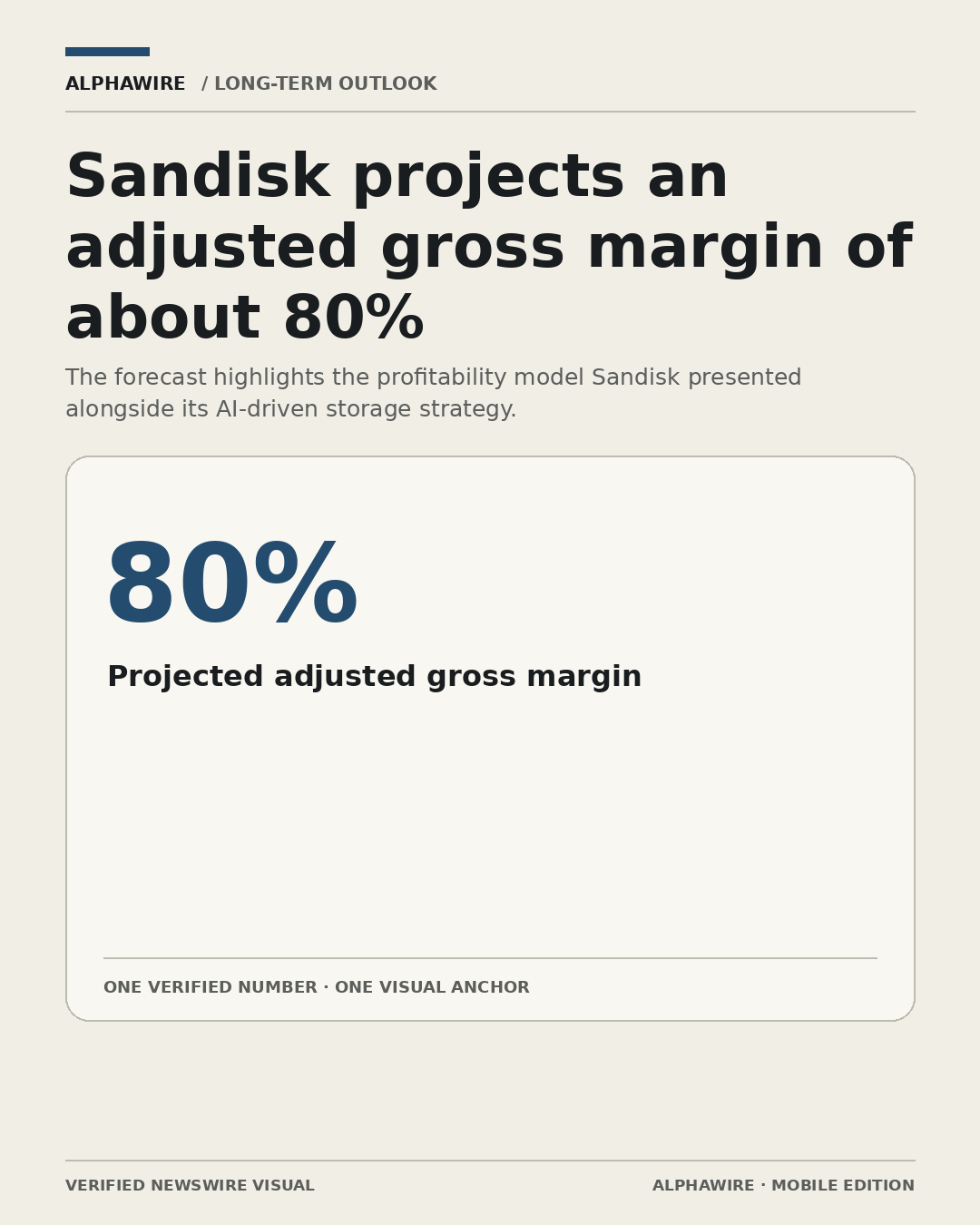
At its investor day on Aug. 13, Sandisk unveiled a growth strategy and long-term financial model extending through fiscal 2030. The company expects revenue to grow at a mid- to high-teens rate from fiscal 2028 through fiscal 2030. It also expects an adjusted gross margin of about 80%, an adjusted operating margin of about 75% and a free-cash-flow margin of about 50%.
Sandisk said that after completing its business investments, it plans to return 100% of its remaining cash to shareholders.
The long-term profitability model, which analysts described as moving beyond the traditional NAND flash-memory cycle, was quickly embraced by investors. Sandisk shares rose 13.67% at Thursday's close, making the stock one of the S&P 500's best performers that day.
The move came after Sandisk's stock briefly fell following the company’s release of record quarterly results on Aug. 5. The decline was mainly attributed to Sandisk's revenue guidance of $10.3 billion to $10.8 billion for the following quarter, below the market's estimate of about $10.82 billion. At the time, investors questioned whether Sandisk could sustain its growth amid elevated expectations.
The investor day appeared to be Sandisk's positive response to the market's earlier concern that its results had already peaked.
Analysts said Sandisk used the investor day to argue that AI is changing the structure of demand in the NAND industry and that the company is using technology upgrades, product-mix adjustments and long-term contracts to smooth the traditional storage industry's cyclicality.
AI inference seen driving storage demand
Against the backdrop of continued expansion in AI infrastructure, Sandisk is especially optimistic about storage demand generated by AI inference.
The company said that as the number of tokens generated and processed by AI surges, key-value (KV) caches are reshaping tiered storage architectures in data centers. Sandisk estimates that the total addressable market for flash memory in enterprise data centers will reach 1.2 zettabytes by 2030.
That means AI-related storage demand will not come only from data processing during the training phase. As the scale of AI inference expands, data centers will also need to process, cache and retain growing volumes of data, potentially making enterprise solid-state drives and other flash products important beneficiaries of AI infrastructure expansion.
Sandisk also announced a product roadmap aimed at AI workloads.
The company said its next-generation BiCS9 QLC product uses CBA, or CMOS directly Bonded to Array, technology. It combines a mature BiCS8 memory-array wafer with a CMOS logic wafer based on BiCS10 technology, allowing Sandisk to introduce products for specific requirements with relatively high capital efficiency.
At the same time, Sandisk said the BiCS10 QLC node delivers a 60% increase in bit density compared with BiCS8, with the goal of achieving a better balance among storage density, performance and power consumption.
In July, Sandisk also announced that it had begun sampling BiCS10 1Tb TLC 3D NAND. The product uses 10th-generation 3D NAND technology and offers interface speeds of up to 4.8 Gb/s, while providing a 59% increase in bit density compared with BiCS8.
Sandisk is also advancing its HBF, or High Bandwidth Flash, technology. The company said that as AI inference workloads grow, the traditional memory-and-storage hierarchy is being restructured, and high-bandwidth flash could become an additional storage layer between high-performance computing and high-capacity storage.
Long-term customer agreements
Cyclicality has long been the storage industry's biggest challenge. When NAND prices rise, manufacturers' profits can expand rapidly. But when supply and demand reverse, falling average selling prices can quickly compress margins. As a result, relying solely on higher prices is unlikely to support a multiyear forecast for high profitability.
Sandisk's answer is a new business model, or NBM, agreement.
The company disclosed that it has signed NBM agreements with eight customers. The agreements are based on committed purchase volumes, binding contractual frameworks, minimum financial guarantees and structured pricing mechanisms.
Sandisk forecasts that demand covered by these agreements will represent about 50% of bit shipments in 2027 and roughly two-thirds of bit shipments in 2028.
Sandisk is attempting to shift part of its traditional spot-market, cyclical NAND sales model toward more stable long-term customer partnerships. Goldman Sachs said, however, that it remains to be seen in practice whether the new long-term customer model can genuinely smooth industry-cycle fluctuations.
Source: The Paper.