U.S. foodborne illness outbreaks surge this summer, with 10,500 cases reported so far
Summer is typically the peak season for foodborne illness, but the frequency, scale and impact of outbreaks in the United States this year have been unusually high. Over the past two months alone, the Food and Drug Administration has released reports on more than 10 foodborne illness outbreak investigations. The agency has released 20 investigation results so far this year, while 18 investigations remain ongoing. From 2021 through 2025, the FDA investigated an average of about 25 foodborne illness outbreaks annually. The unusually high outbreak activity is partly linked to this year's rare heat, which has contributed to food contamination and the spread of a difficult-to-trace pathogen. The Trump administration's cuts to federal funding have also reduced food-inspection budgets at federal agencies, while funding for state and local health departments to trace outbreak sources and conduct traceback investigations has also declined. Food-safety experts said the frequency of outbreaks this summer has been shocking. Darin Detwiler, a food-safety advocate and former professor of food policy and corporate social responsibility at Northeastern University, said the United States is facing what may be its worst year on record when measured across five dimensions: severity, frequency, scale, public-health burden and system performance. According to data from the FDA and the Centers for Disease Control and Prevention, the United States has recorded about 10,500 foodborne illness cases linked to outbreaks so far this year. That is seven times the annual average of about 1,500 cases from 2021 through 2025. The ongoing investigations involve the four pathogens that have been the most common causes of outbreaks over the past five years: Cyclospora, E. coli, Listeria and Salmonella. The overwhelming majority of this year's cases are linked to a Cyclospora outbreak involving romaine lettuce used by restaurants including Taco Bell. As of Thursday, Aug. 13, at least 9,481 cases were linked to the Cyclospora outbreak across 17 states. That is more than the combined total reported in all outbreaks over the past four years. It is the largest Cyclospora outbreak ever recorded in the United States and one of the largest foodborne illness outbreaks on record. The United States has also experienced large outbreaks this year linked to Mexican peppers, moringa leaf powder, eggs and cantaloupe. Several types of Salmonella were detected in those products. Janet Hamilton, executive director of the Council of State and Territorial Epidemiologists, said the United States is experiencing unprecedented large-scale outbreaks. She said these illnesses are complex even under the best circumstances, and the number and scale of outbreaks have now exceeded the system's capacity. The FDA also warned in a statement that the sources of some outbreaks have not yet been identified. Public-health experts said uncertainty about the sources could allow outbreaks to grow larger than they otherwise might have.
Over the past two months alone, the Food and Drug Administration has released reports on more than 10 foodborne illness outbreak investigations. The agency has released 20 investigation results so far this year, while 18 investigations remain ongoing. From 2021 through 2025, the FDA investigated an average of about 25 foodborne illness outbreaks annually.
The unusually high outbreak activity is partly linked to this year's rare heat, which has contributed to food contamination and the spread of a difficult-to-trace pathogen. The Trump administration's cuts to federal funding have also reduced food-inspection budgets at federal agencies, while funding for state and local health departments to trace outbreak sources and conduct traceback investigations has also declined.
Food-safety experts said the frequency of outbreaks this summer has been shocking. Darin Detwiler, a food-safety advocate and former professor of food policy and corporate social responsibility at Northeastern University, said the United States is facing what may be its worst year on record when measured across five dimensions: severity, frequency, scale, public-health burden and system performance.
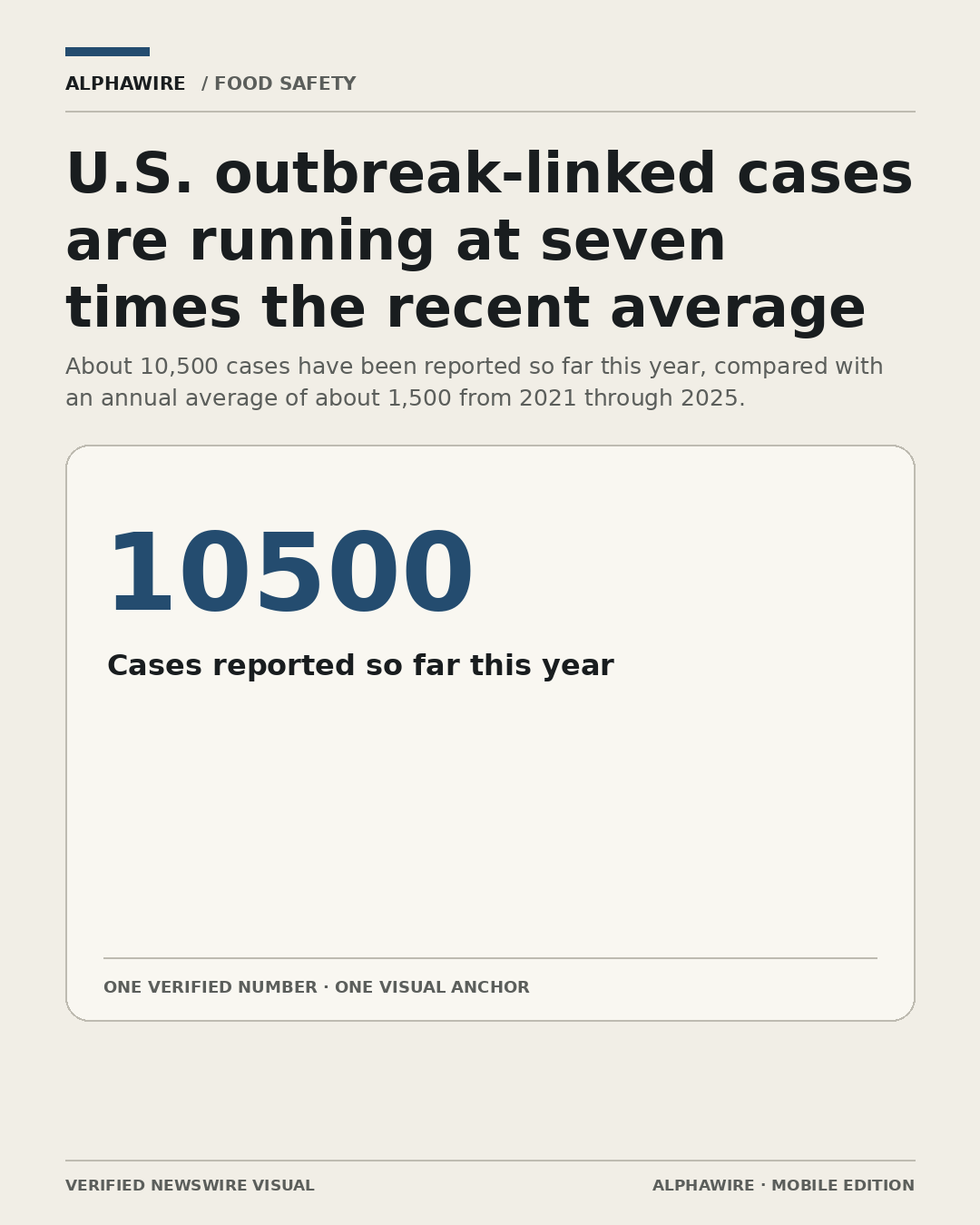
According to data from the FDA and the Centers for Disease Control and Prevention, the United States has recorded about 10,500 foodborne illness cases linked to outbreaks so far this year. That is seven times the annual average of about 1,500 cases from 2021 through 2025.
The ongoing investigations involve the four pathogens that have been the most common causes of outbreaks over the past five years: Cyclospora, E. coli, Listeria and Salmonella. The overwhelming majority of this year's cases are linked to a Cyclospora outbreak involving romaine lettuce used by restaurants including Taco Bell.
As of Thursday, Aug. 13, at least 9,481 cases were linked to the Cyclospora outbreak across 17 states. That is more than the combined total reported in all outbreaks over the past four years. It is the largest Cyclospora outbreak ever recorded in the United States and one of the largest foodborne illness outbreaks on record.
The United States has also experienced large outbreaks this year linked to Mexican peppers, moringa leaf powder, eggs and cantaloupe. Several types of Salmonella were detected in those products.
Janet Hamilton, executive director of the Council of State and Territorial Epidemiologists, said the United States is experiencing unprecedented large-scale outbreaks. She said these illnesses are complex even under the best circumstances, and the number and scale of outbreaks have now exceeded the system's capacity.
The FDA also warned in a statement that the sources of some outbreaks have not yet been identified. Public-health experts said uncertainty about the sources could allow outbreaks to grow larger than they otherwise might have.