Asia-Pacific Markets Slide as Japan Rate-Hike Bets Rise and U.S. Plans Iran Blockade
Asia-Pacific markets weakened on Aug. 14 as Japanese stocks reversed earlier gains amid rising expectations for a Bank of Japan rate hike and the United States prepared new economic measures against Iran. Japan’s Nikkei 225 futures turned lower and fell more than 0.7%, while TOPIX futures dropped 0.3% after both indexes had performed strongly in morning trading. Hong Kong and other Asia-Pacific markets also moved lower. U.S. and European stock futures showed signs of weakness as well. Market sentiment was pressured by two developments. On Polymarket, bettors currently put the probability of a Bank of Japan rate hike in September at 81%, up from 22% two weeks earlier. Separately, the United States said it would impose what it called “unprecedented” economic isolation measures against Iran next week. Japan’s market performance helped set the tone for the region. Japanese stocks weakened in afternoon trading, with Nikkei 225 futures falling sharply and TOPIX futures also selling off. Commodities posted another steep decline, extending losses for a second consecutive day. Japanese government bonds with maturities of five years or longer fell across the curve. U.S. Treasurys with maturities of six months or longer also declined across the curve. In foreign-exchange trading, the dollar fell sharply against the yen as the market only began fully pricing in the impact of a possible Bank of Japan rate hike on Aug. 14. Goldman Sachs said Japan’s intervention was the country’s largest foreign-exchange intervention in 15 years and prompted large-scale unwinding of yen-related tactical carry positions. The firm said the size of the unwinding was greater than during the initial phase of Japan’s July 2024 intervention. Although speculative positions have already contracted significantly, another wave of unwinding could occur when market conditions are ripe. If macroeconomic fundamentals and market conditions favor further yen gains, the positions could even turn net long, repeating the move seen from July to August 2024. The market currently puts the probability of a September Bank of Japan rate hike above 80%. If the central bank tightens monetary policy faster than expected while the global economic-growth framework remains unchanged, the yen’s strength could last longer. A sustained, structural unwinding of positions would require Japanese investors to repatriate funds from unhedged overseas assets. Overseas-asset yields remain attractive, however, and official portfolio-flow data have not yet shown signs of such a shift. Without faster Bank of Japan rate hikes, a repatriation of funds or other drivers capable of supporting a sustained yen rally, the boost from the intervention could gradually fade. The yen could still fall again and set new lows. Mitsuhiro Furusawa, a former finance official at Japan’s Ministry of Finance, said Japan could conduct coordinated yen intervention at any time while signaling or taking rate-hike measures earlier than the market expects to curb the yen’s decline. He said the yen is currently clearly undervalued, which is driving up import costs and weighing on the domestic economy. Furusawa added that if the exchange rate returns to the level seen before the Japan-U.S. coordinated intervention last month, the two countries could again intervene jointly. He expects the Bank of Japan to most likely begin raising rates in September, followed by another hike in December or January next year. He put the central bank’s medium- to long-term target rate range at about 1.5% to 1.75%. The structure of China’s A-share market also reflected expectations of renewed geopolitical turmoil. The A-share dividend index surged in afternoon trading and was up more than 0.8% at one point. U.S. Treasury Secretary Scott Bessent said Thursday local time that the Trump administration plans to announce a new round of economic measures against Iran next week to apply further financial pressure on Tehran and force concessions. In an interview with Newsmax, Bessent said, “Please watch for more next week, because we are going to implement measures that no country has ever seen in the history of economic isolation.” Bessent said the new measures would be combined with the U.S. maritime blockade of Iranian ports already in place, creating a further “one-two punch” of pressure. “This will be a combination of economic isolation the world has never seen and the ongoing blockade of the Strait of Hormuz, which will prevent anything from entering or leaving Iranian ports,” he said, without providing further details. U.S. Defense Secretary Pete Hegseth said the same day in an interview with reporters in Panama that the U.S. military could maintain the blockade for an extended period because naval ships could rotate continuously. “The U.S. Navy can maintain this kind of blockade indefinitely, because we will rotate ships in and out as we are doing now, and we will continue to do so,” Hegseth said. According to CCTV International News, Vice President JD Vance said in an interview on Aug. 13 local time that he was confident the United States would achieve its dual objectives in dealing with Iran: preventing Iran from obtaining nuclear weapons and keeping energy prices stable. Vance said the United States would be “in a more favorable position” after its confrontation with Iran, and that the Trump administration was using diplomatic, military and economic tools “very selectively and highly strategically” to achieve its goals. He added that the situation remained unpredictable because Iran “sometimes fails to honor its commitments to us.”
Japan’s Nikkei 225 futures turned lower and fell more than 0.7%, while TOPIX futures dropped 0.3% after both indexes had performed strongly in morning trading. Hong Kong and other Asia-Pacific markets also moved lower. U.S. and European stock futures showed signs of weakness as well.
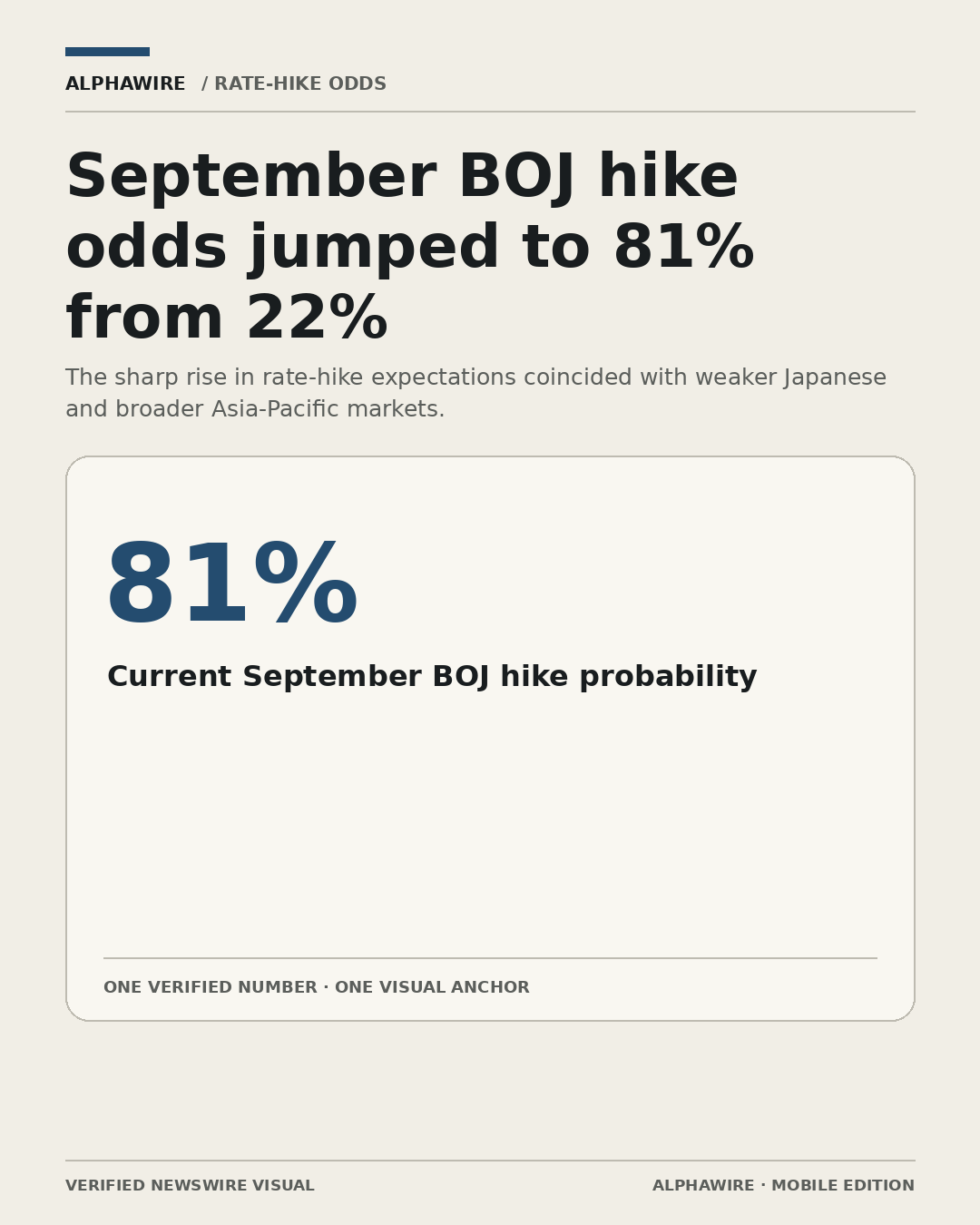
Market sentiment was pressured by two developments. On Polymarket, bettors currently put the probability of a Bank of Japan rate hike in September at 81%, up from 22% two weeks earlier. Separately, the United States said it would impose what it called “unprecedented” economic isolation measures against Iran next week.
Japan’s market performance helped set the tone for the region. Japanese stocks weakened in afternoon trading, with Nikkei 225 futures falling sharply and TOPIX futures also selling off. Commodities posted another steep decline, extending losses for a second consecutive day.
Japanese government bonds with maturities of five years or longer fell across the curve. U.S. Treasurys with maturities of six months or longer also declined across the curve.
In foreign-exchange trading, the dollar fell sharply against the yen as the market only began fully pricing in the impact of a possible Bank of Japan rate hike on Aug. 14.
Goldman Sachs said Japan’s intervention was the country’s largest foreign-exchange intervention in 15 years and prompted large-scale unwinding of yen-related tactical carry positions. The firm said the size of the unwinding was greater than during the initial phase of Japan’s July 2024 intervention. Although speculative positions have already contracted significantly, another wave of unwinding could occur when market conditions are ripe. If macroeconomic fundamentals and market conditions favor further yen gains, the positions could even turn net long, repeating the move seen from July to August 2024.
The market currently puts the probability of a September Bank of Japan rate hike above 80%. If the central bank tightens monetary policy faster than expected while the global economic-growth framework remains unchanged, the yen’s strength could last longer.
A sustained, structural unwinding of positions would require Japanese investors to repatriate funds from unhedged overseas assets. Overseas-asset yields remain attractive, however, and official portfolio-flow data have not yet shown signs of such a shift. Without faster Bank of Japan rate hikes, a repatriation of funds or other drivers capable of supporting a sustained yen rally, the boost from the intervention could gradually fade. The yen could still fall again and set new lows.
Mitsuhiro Furusawa, a former finance official at Japan’s Ministry of Finance, said Japan could conduct coordinated yen intervention at any time while signaling or taking rate-hike measures earlier than the market expects to curb the yen’s decline. He said the yen is currently clearly undervalued, which is driving up import costs and weighing on the domestic economy. Furusawa added that if the exchange rate returns to the level seen before the Japan-U.S. coordinated intervention last month, the two countries could again intervene jointly. He expects the Bank of Japan to most likely begin raising rates in September, followed by another hike in December or January next year. He put the central bank’s medium- to long-term target rate range at about 1.5% to 1.75%.
The structure of China’s A-share market also reflected expectations of renewed geopolitical turmoil. The A-share dividend index surged in afternoon trading and was up more than 0.8% at one point.
U.S. Treasury Secretary Scott Bessent said Thursday local time that the Trump administration plans to announce a new round of economic measures against Iran next week to apply further financial pressure on Tehran and force concessions. In an interview with Newsmax, Bessent said, “Please watch for more next week, because we are going to implement measures that no country has ever seen in the history of economic isolation.”
Bessent said the new measures would be combined with the U.S. maritime blockade of Iranian ports already in place, creating a further “one-two punch” of pressure. “This will be a combination of economic isolation the world has never seen and the ongoing blockade of the Strait of Hormuz, which will prevent anything from entering or leaving Iranian ports,” he said, without providing further details.
U.S. Defense Secretary Pete Hegseth said the same day in an interview with reporters in Panama that the U.S. military could maintain the blockade for an extended period because naval ships could rotate continuously. “The U.S. Navy can maintain this kind of blockade indefinitely, because we will rotate ships in and out as we are doing now, and we will continue to do so,” Hegseth said.
According to CCTV International News, Vice President JD Vance said in an interview on Aug. 13 local time that he was confident the United States would achieve its dual objectives in dealing with Iran: preventing Iran from obtaining nuclear weapons and keeping energy prices stable. Vance said the United States would be “in a more favorable position” after its confrontation with Iran, and that the Trump administration was using diplomatic, military and economic tools “very selectively and highly strategically” to achieve its goals. He added that the situation remained unpredictable because Iran “sometimes fails to honor its commitments to us.”